One of the responsibilities of any chaplain is to contribute to the religious support mission of the garrison on which he/she serves. While in Korea I had the opportunity to pastor the Yongsan Traditional Protestant Congregation at Memorial Chapel, which is coming to a close after over 25 years due to the transformation of U.S. forces to Camp Humphreys in order to return the area now occupied by USAG Yongsan to the Republic of Korea.
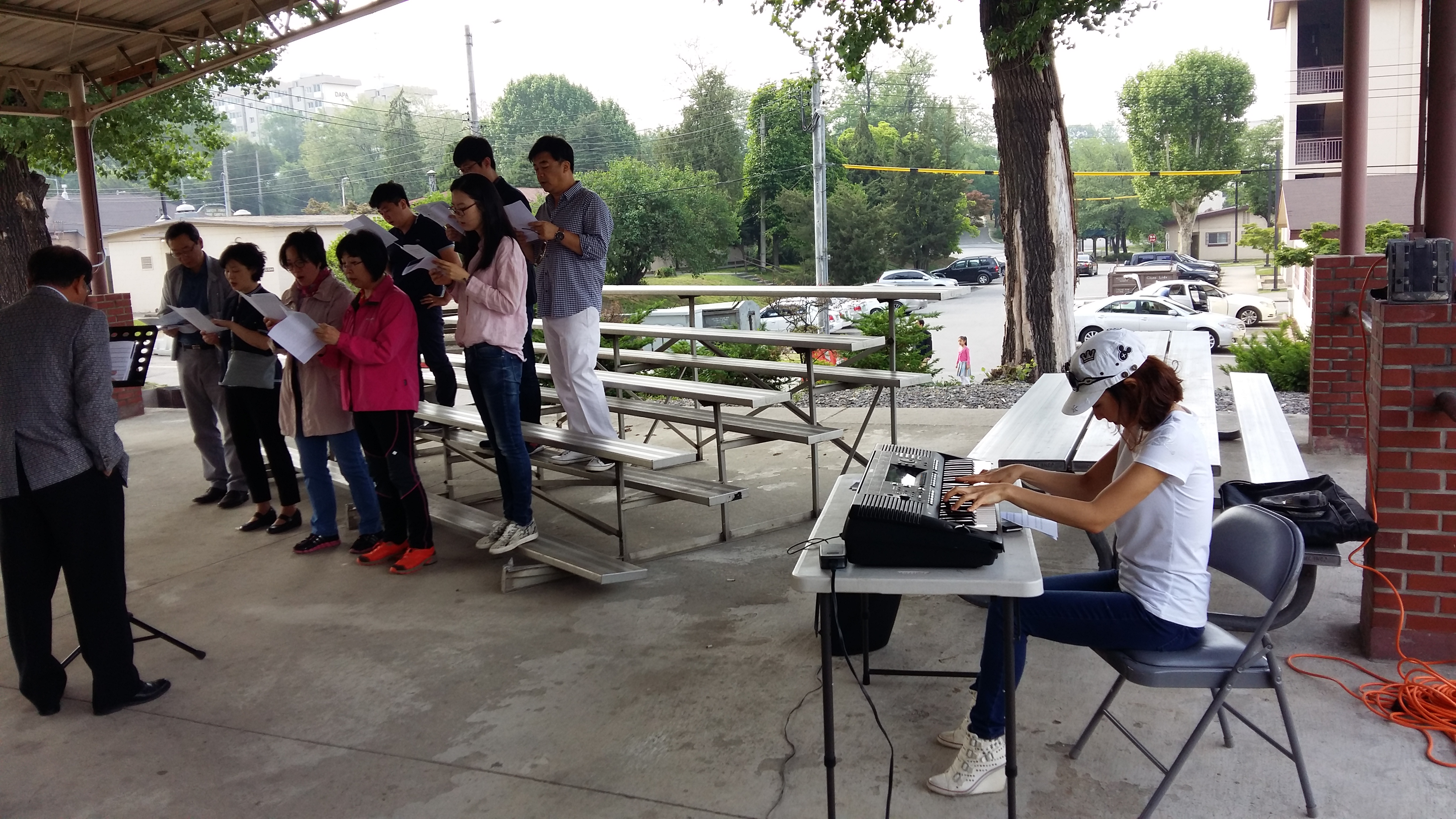
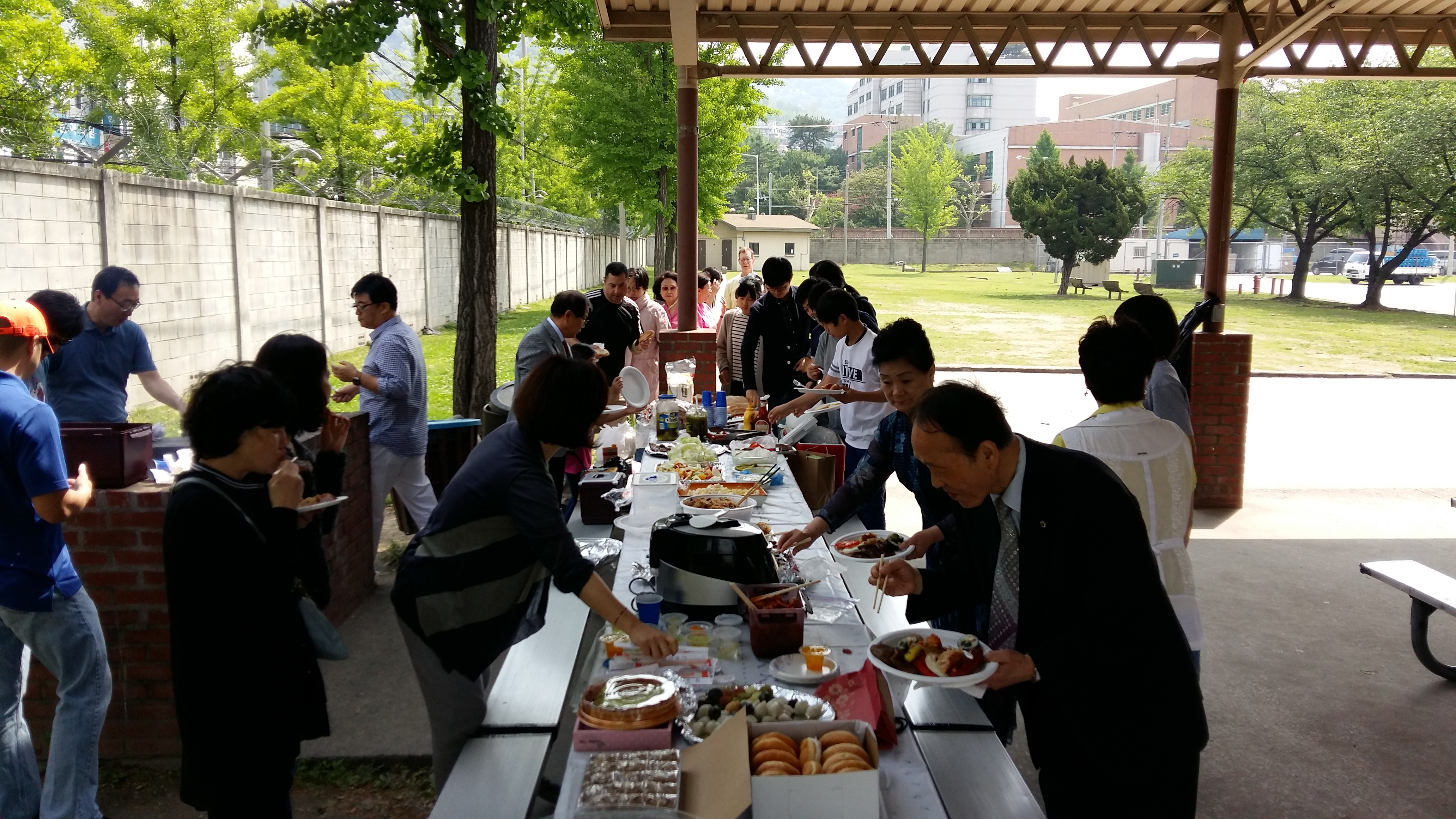
One of the traditions of this congregation that took place annually for many of those 25 years was taking the worship service to a park with a cook-out and picnic following. Today was the day for this annual picnic. We had over 40 in attendance, which represented most of the congregation. There was a threat of rain, but it held off until we were through so we only dealt with the wind that kept us holding our papers tightly.
Congregation and choir worshiping in the park
The choir joined in the hymns and sang the anthem as well as they do in the chapel. When I first arrived in the service, I was amazed at the quality of the music for such a small congregation. Here’s a short video of the chorus of today’s anthem:
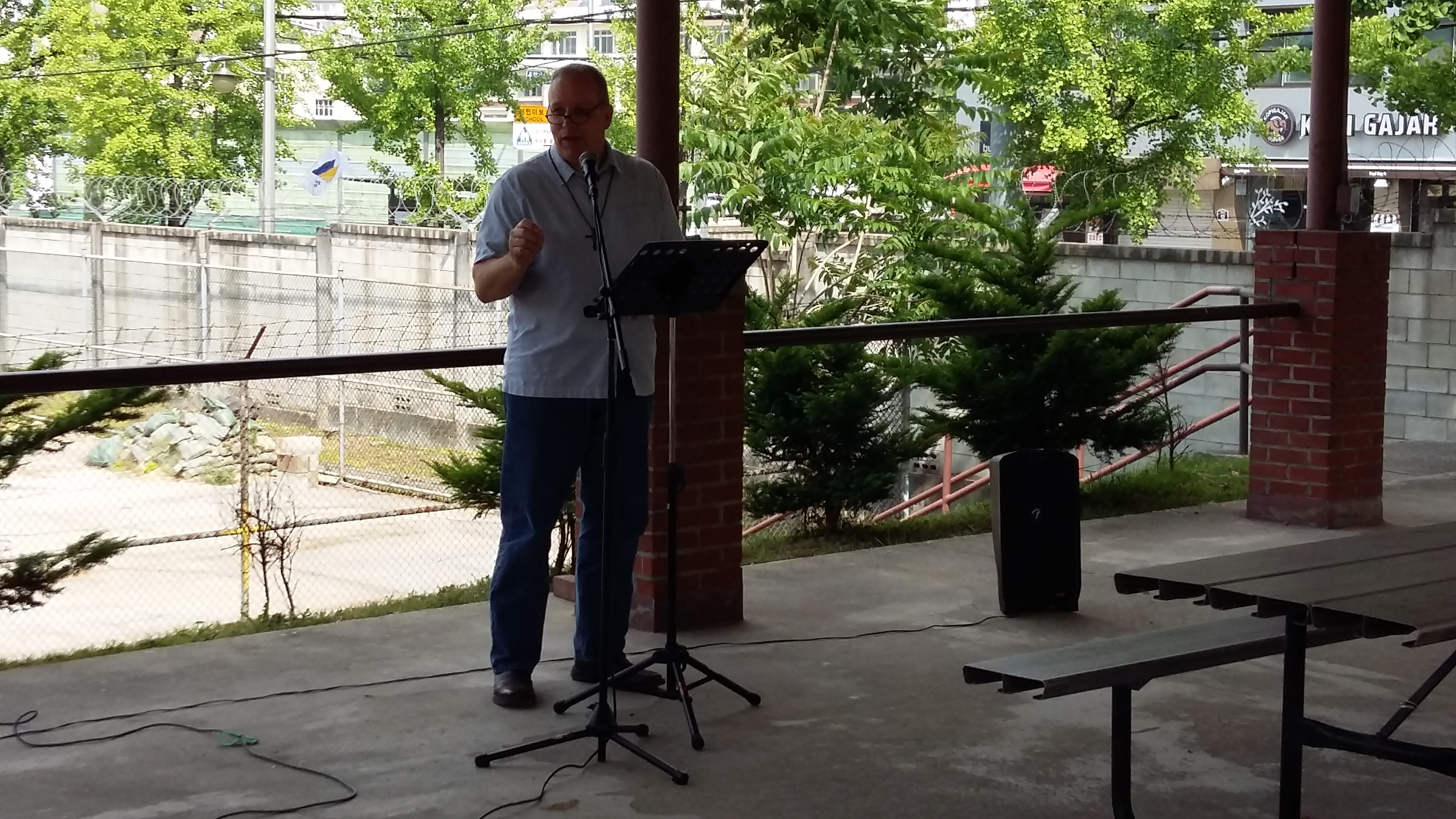
Richard reads the Scripture.The keyboard was not the same as the grand piano in the chapel, but it did the trick.Me preaching from Acts 2 (It was Pentecost Sunday).The meat, buns, condiments, etc. were purchased from congregation funds. The other dishes were brought by congregation members. Many of the dishes were brought in wrapped in gold cloth. Some seemed to have something embroidered on them. Maybe a traditional way of carrying in side dishes?Kalbi marinated short ribs, sausages, hamburgers, and many American and Korean side dishes made for a great lunch.Some of the men of the congregation cooking the meat.
Suwon is one of the Korean cities that I have visited most. It is the capital of Gyeonggi-do, which is South Korea’s most populous province. Suwon is located about 30 kilometers south of Seoul, South Korea’s capital, and has a population of over 1 million. Traditionally it was known as “The City of Filial Piety” and is home to the Hwaseong Fortress.
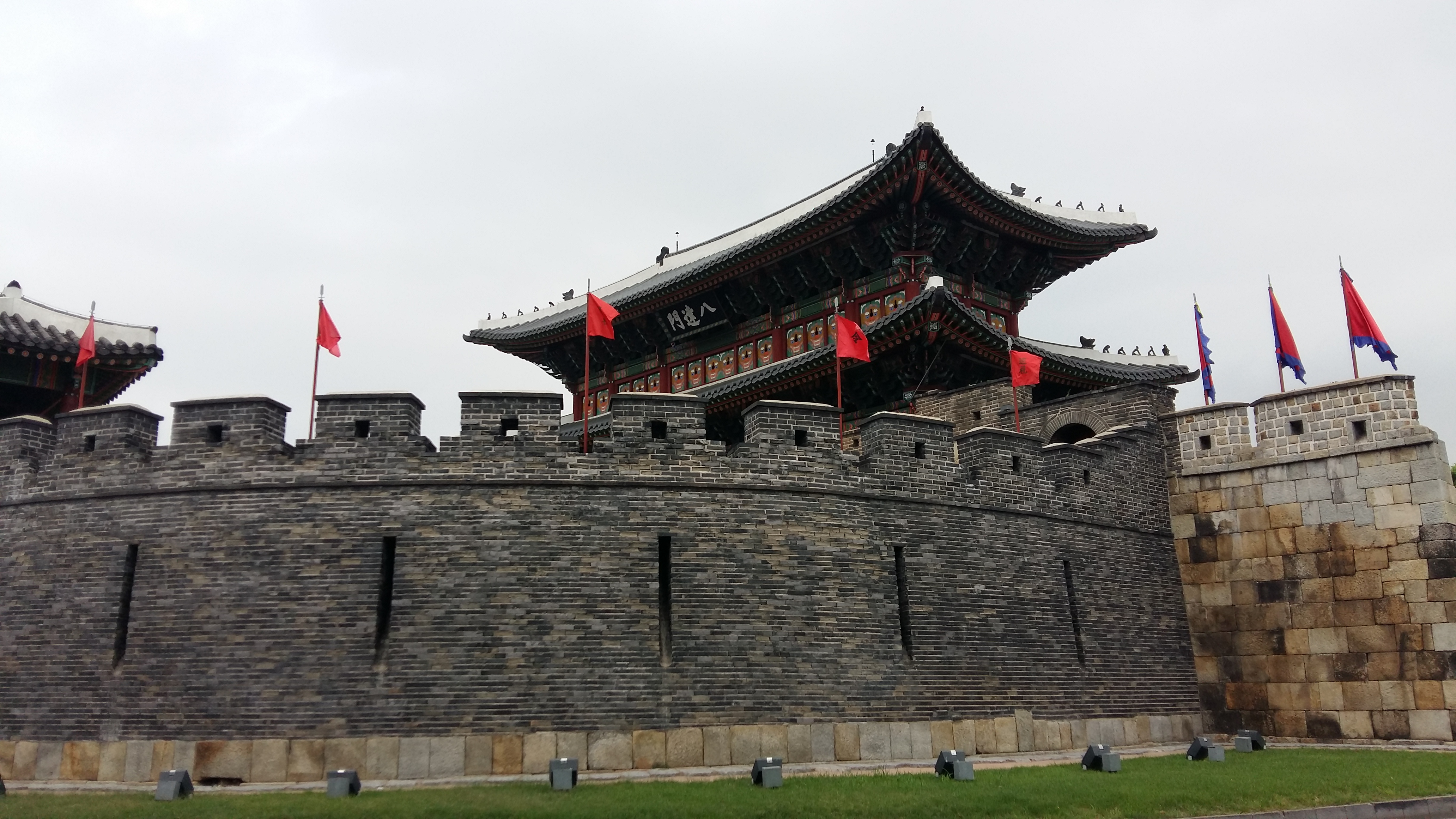
One of the gates of Hwaseong Fortress
Hwaseong Fortress was built as part of a planned city constructed by King Jeongjo, the 22nd monarch of the Joseon Dynasty. It served as the southern gate of the capital city of Seoul during the Joseon Dynasty. Located in Suwon, Gyeonggi-do, the area of Hwaseong Fortress served as a strategic site for military security as well as key site for commerce.
Today, Hwaseong Fortress is surrounded by many roads both small and large, in addition to the Gyeonggi Provincial Government Building, giving all the opportunity to view the scenic juxtaposition of old and modern architecture. For a quick and convenient way to visit a variety of attractions during your stay in Suwon, take a ride on the Suwon City Tour, operated by the city Government. Accompanied by guides who are proficient in English and Japanese, you’ll be able to ride in comfort as you discover some of the most celebrated treasures of the city.1
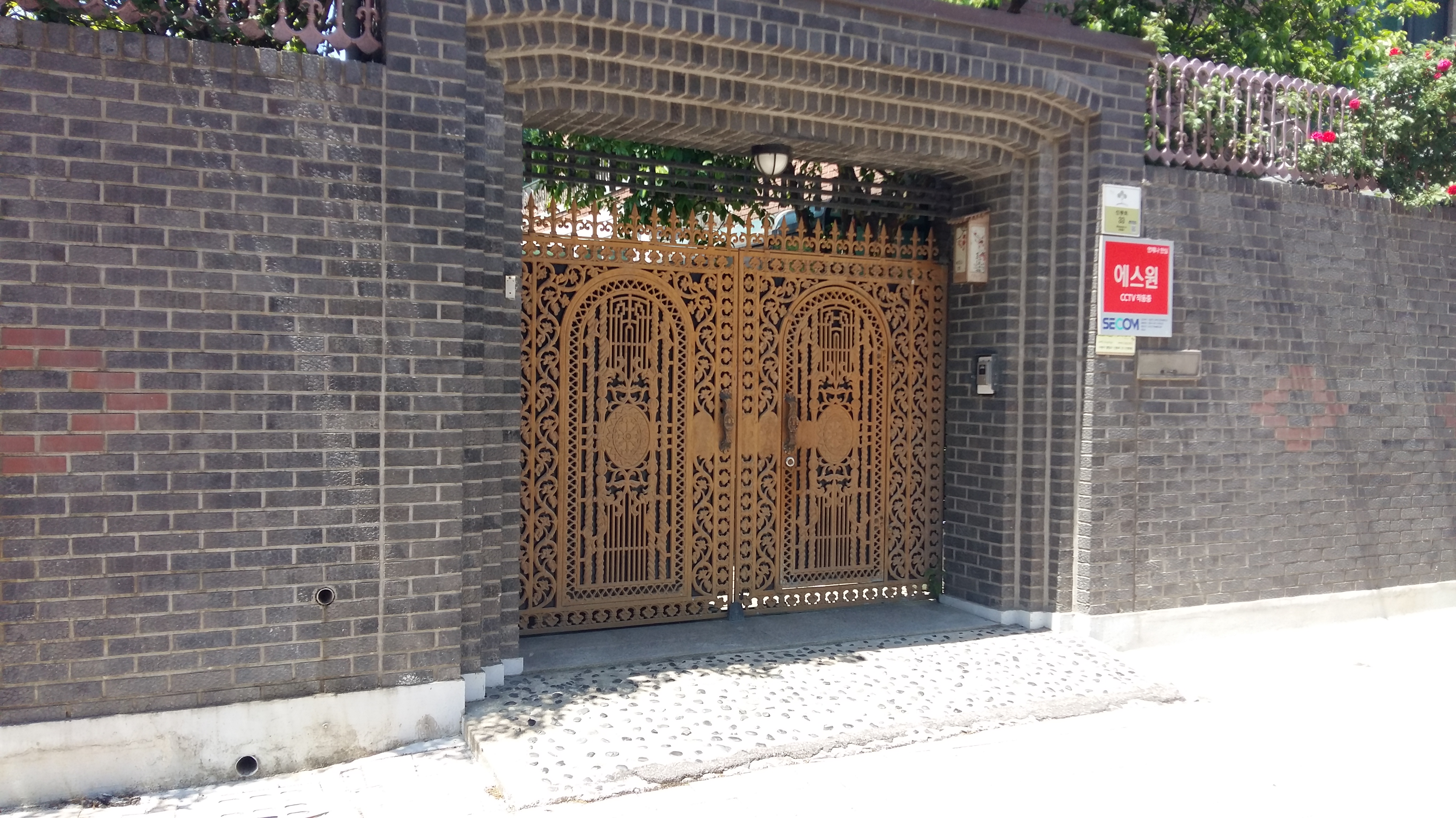
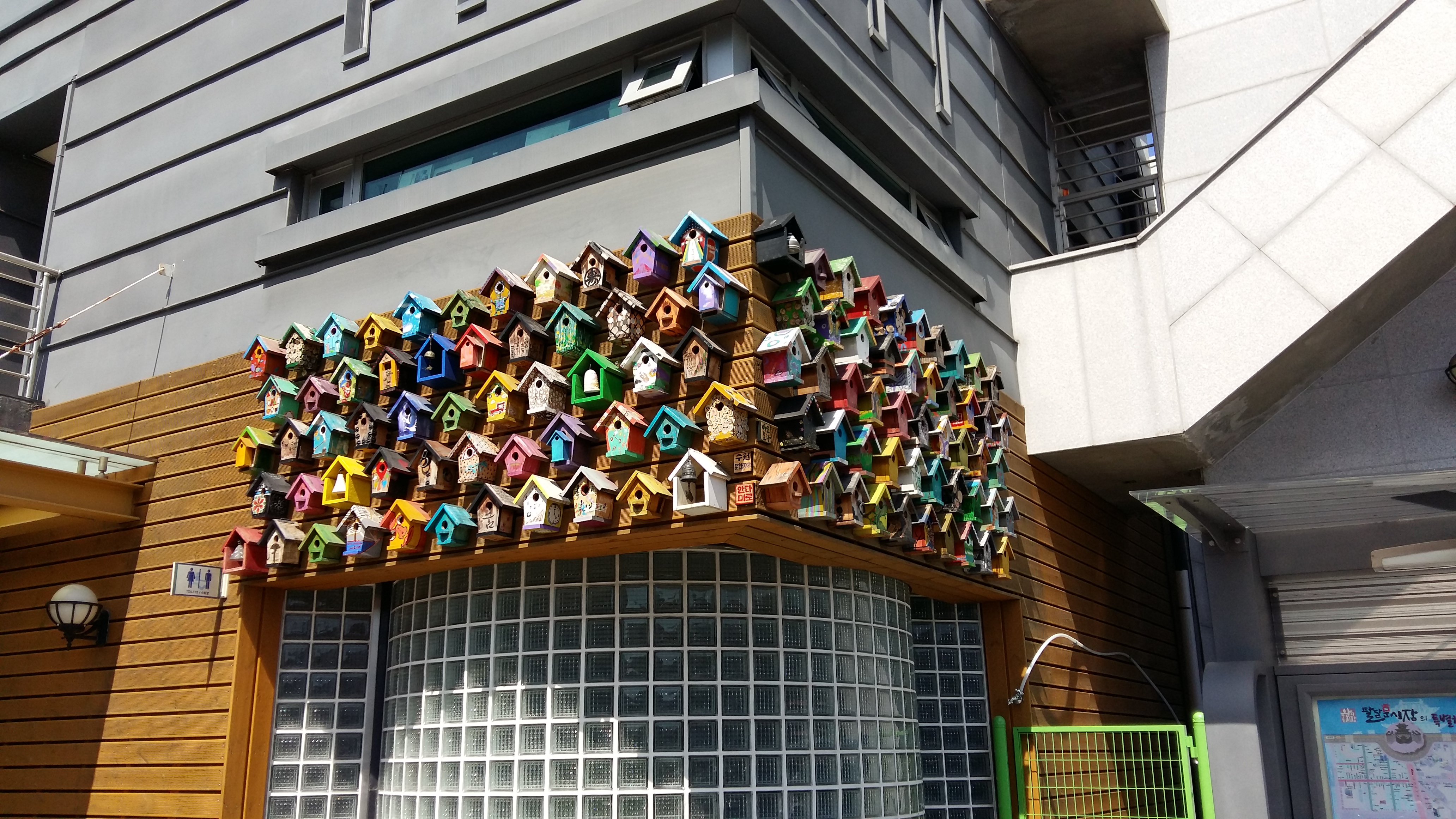
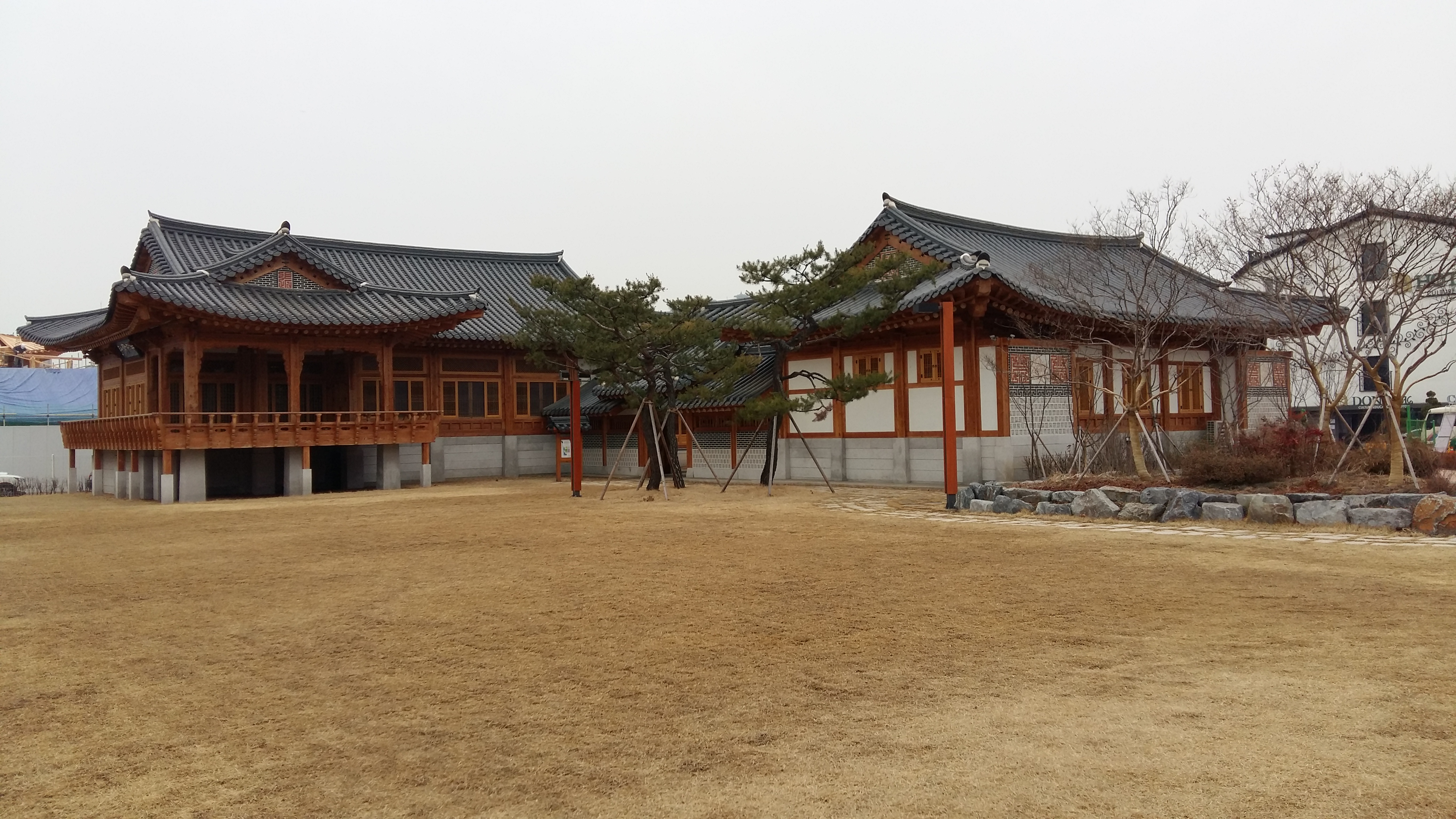
But there is much more to Suwon besides the fortress, including the Haenggung Palaces. Here are a few pictures of my walks around Suwon:
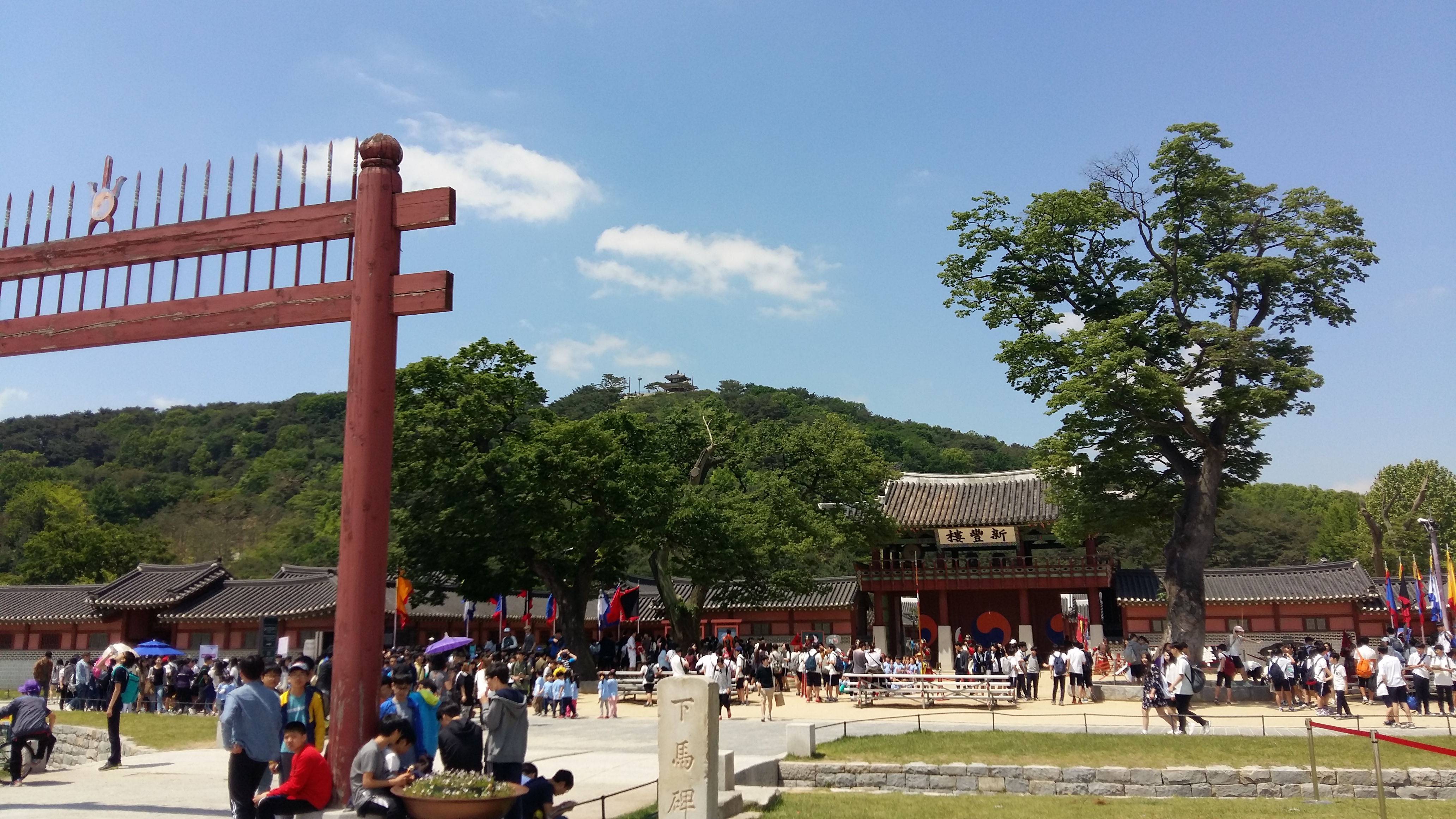
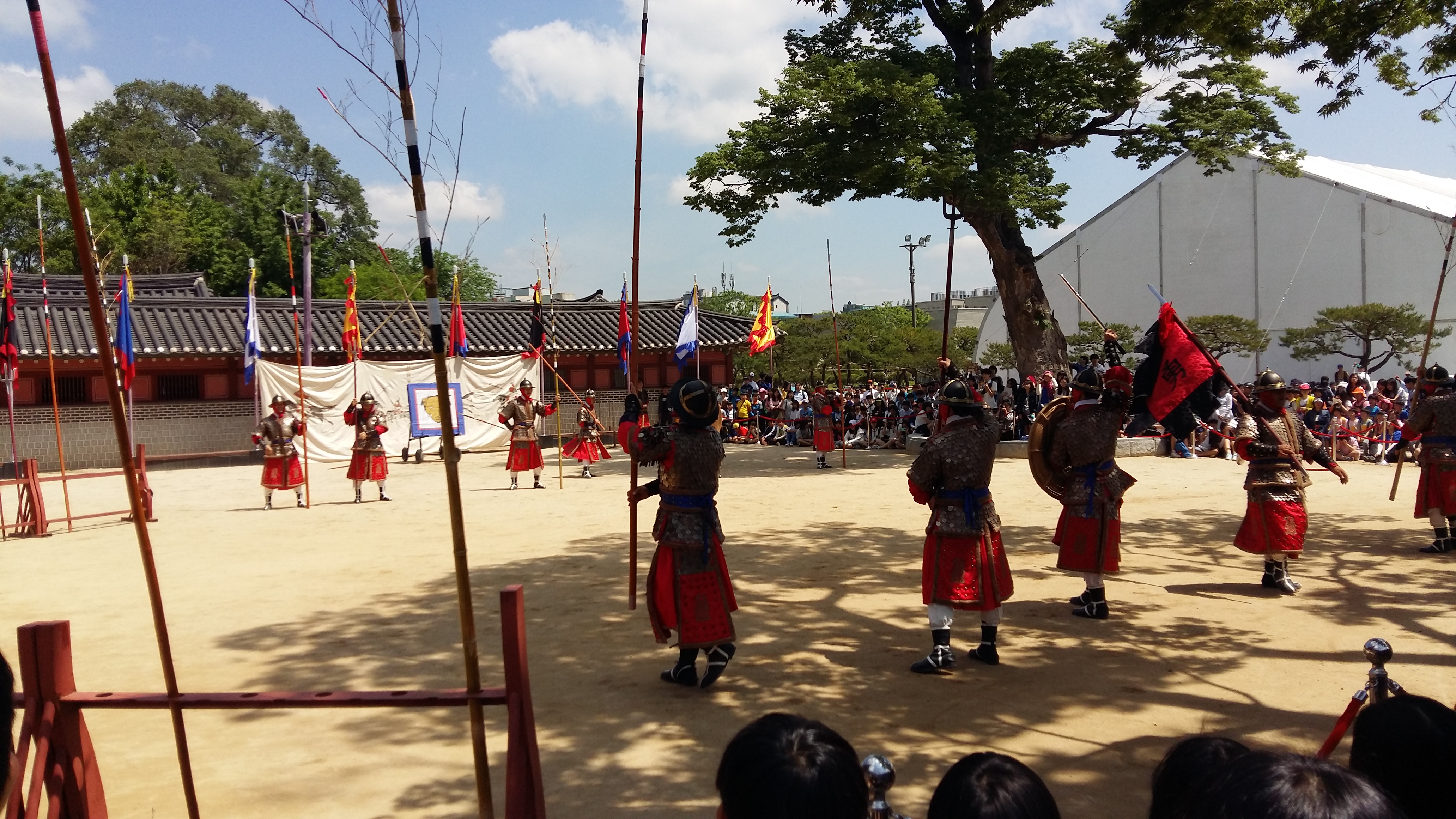
Main entrance to the Hwaseong Haenggung PalaceA view of the Seo Jandae (command post) on the hill over Hwaseong Haenggung Palace.This Zelkova tree in front of the Hwaseong Palace was designated a Protected Tree in 1982. It is said to be 350 years old and represents the meaning that the prime minister and two other ministers greet a benignant person under this tree so as to be engaged in right politics.A warrior demonstration in front of the Hwaseong Haenggung Palace
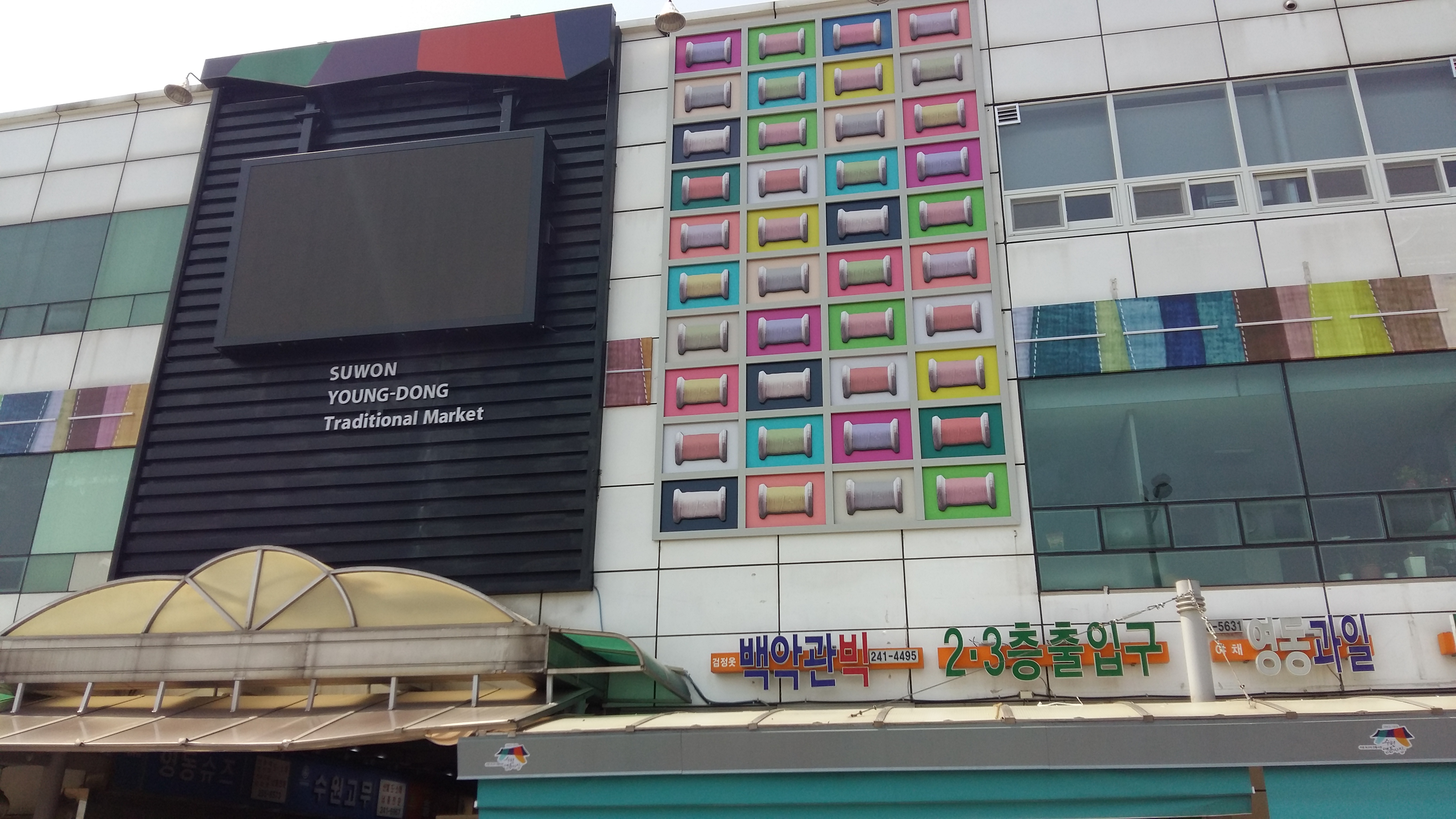
One of the busy side-streets of Suwon
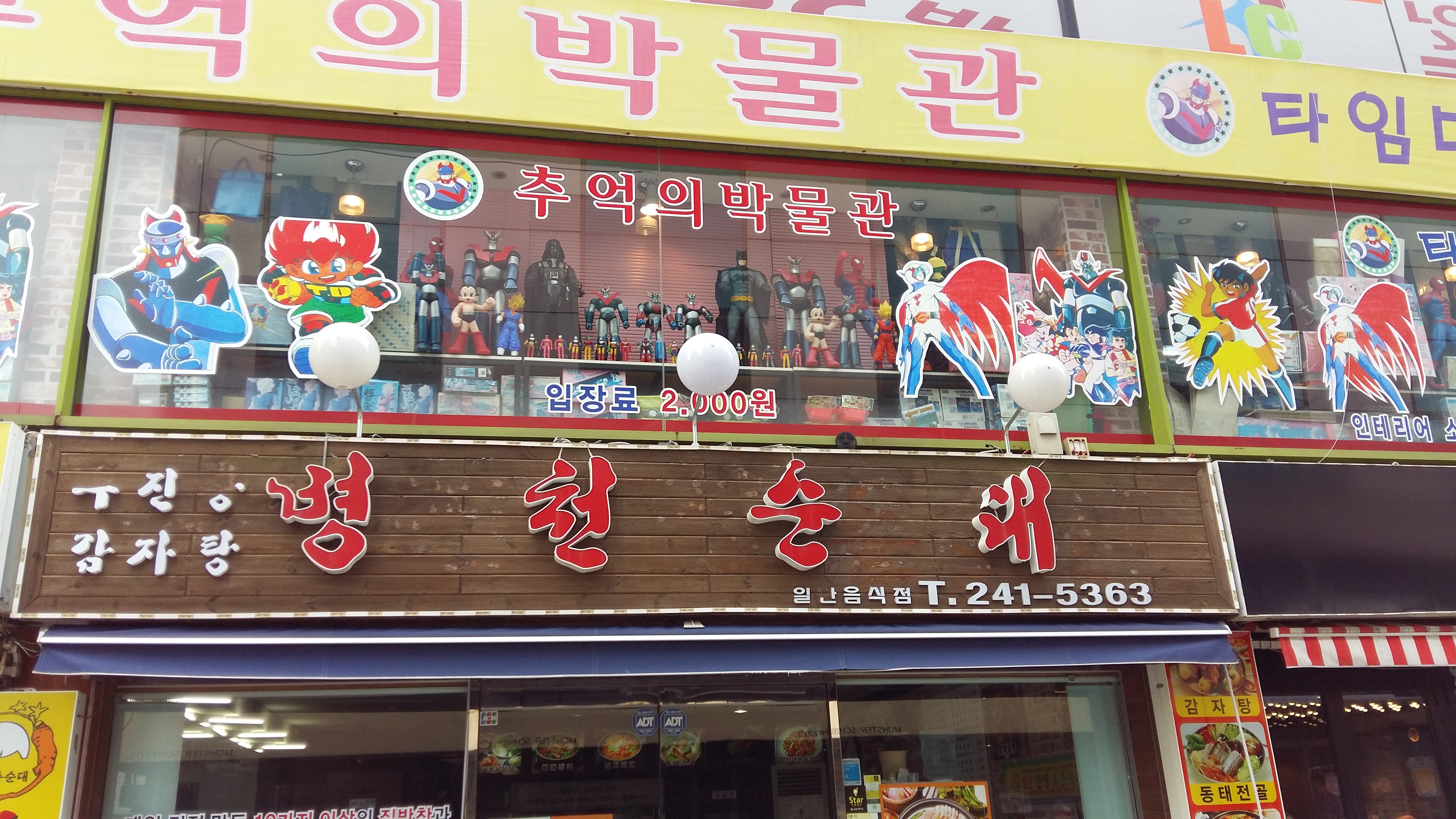
An American collectibles shop in Suwon
There’s a toy museum on the 2nd floor.
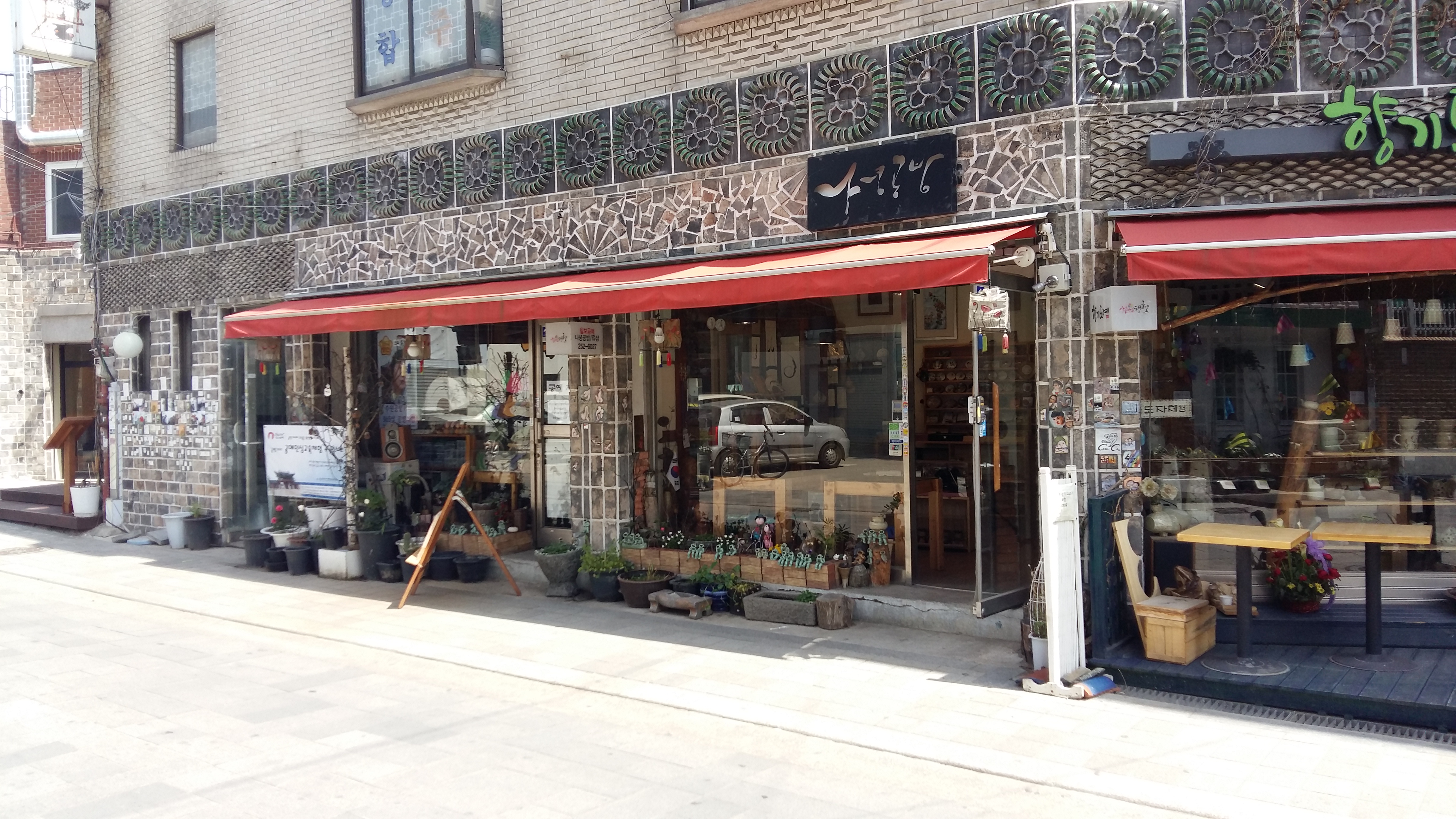
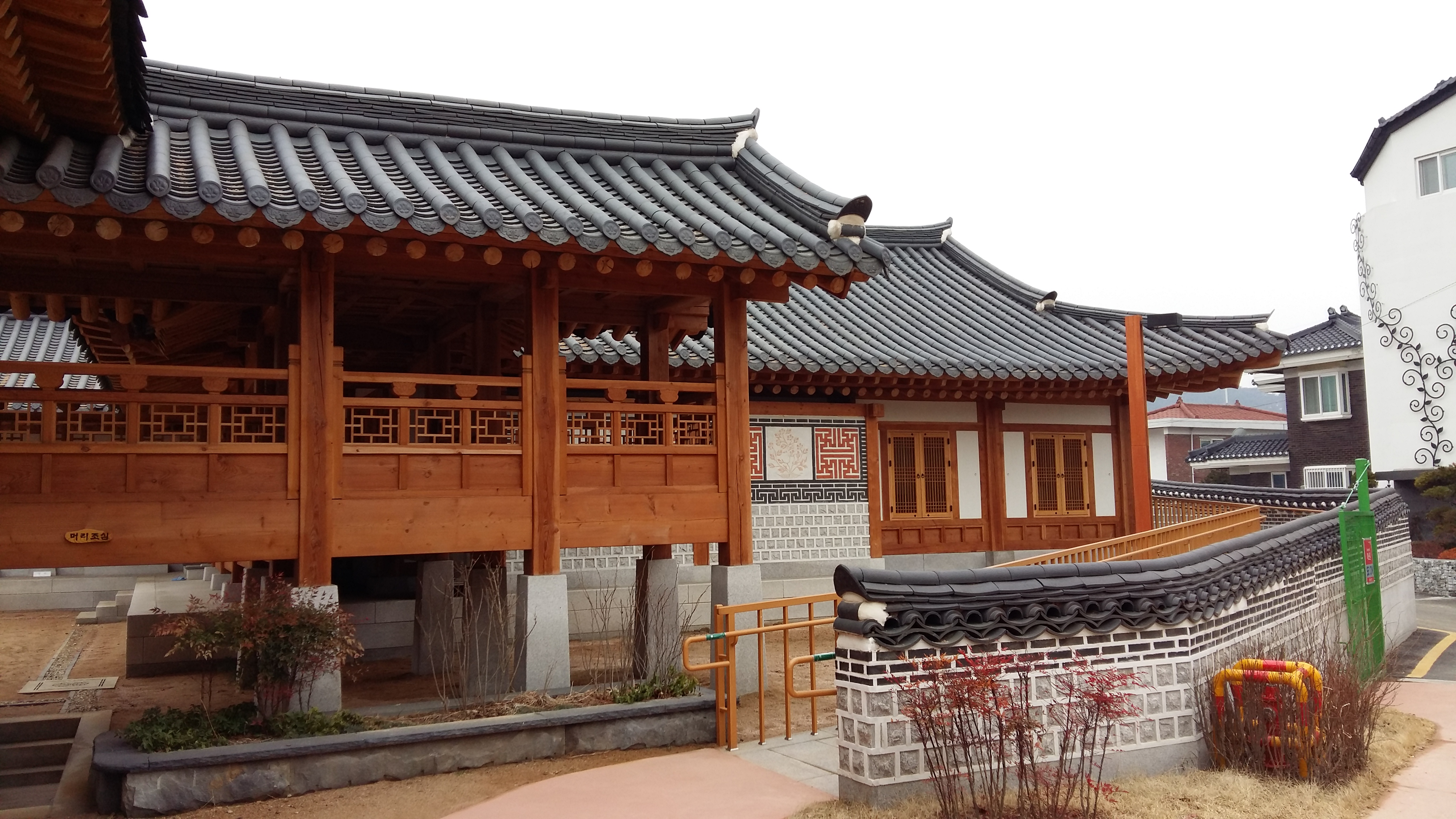
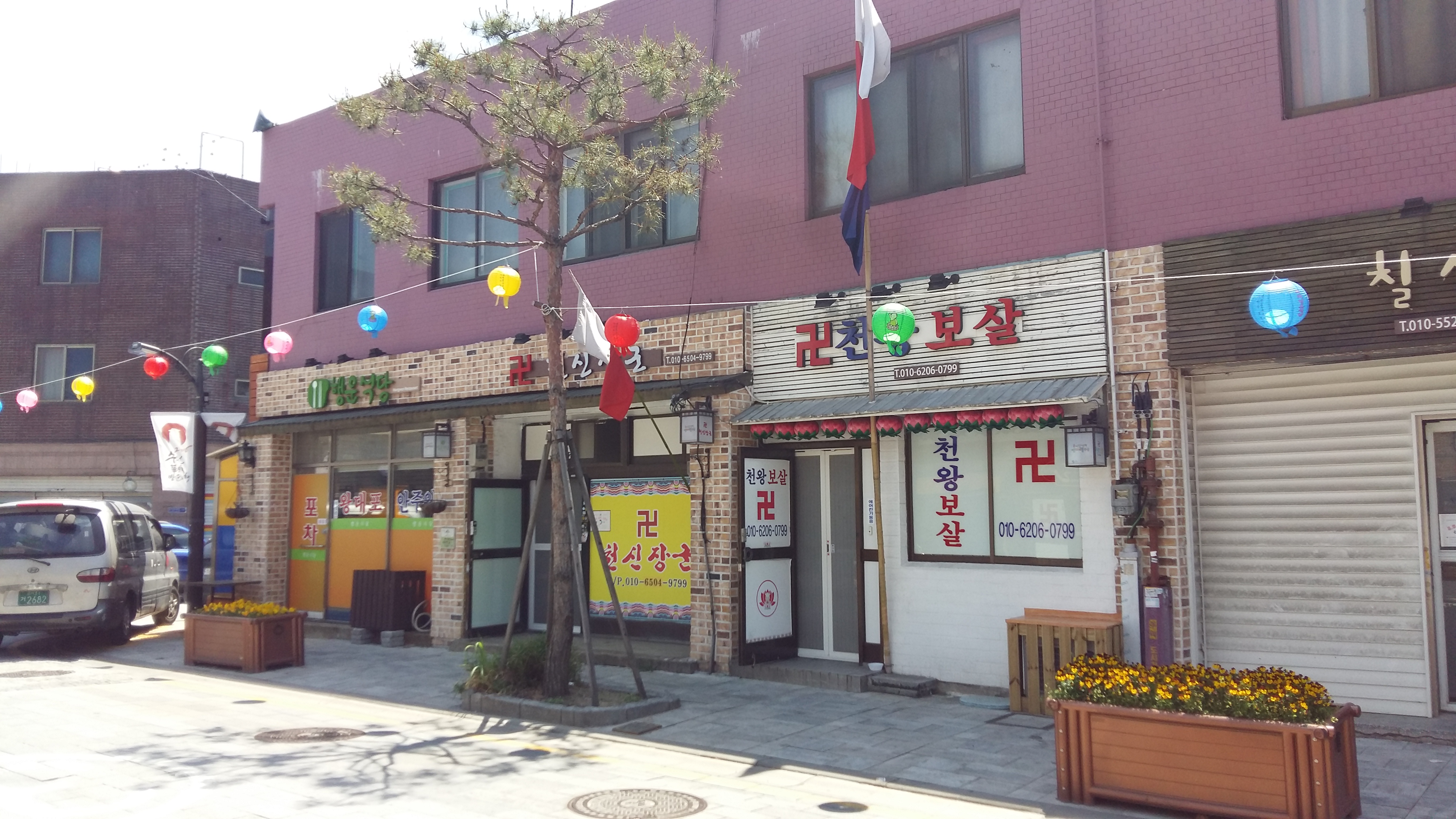
A small traditional village museumA small traditional village museumA small traditional village museumA local artist who I bought some hand-painted magnets fromOne of the Buddhist temples on the weekend of Buddha’s birthday (thus, the paper lanterns).
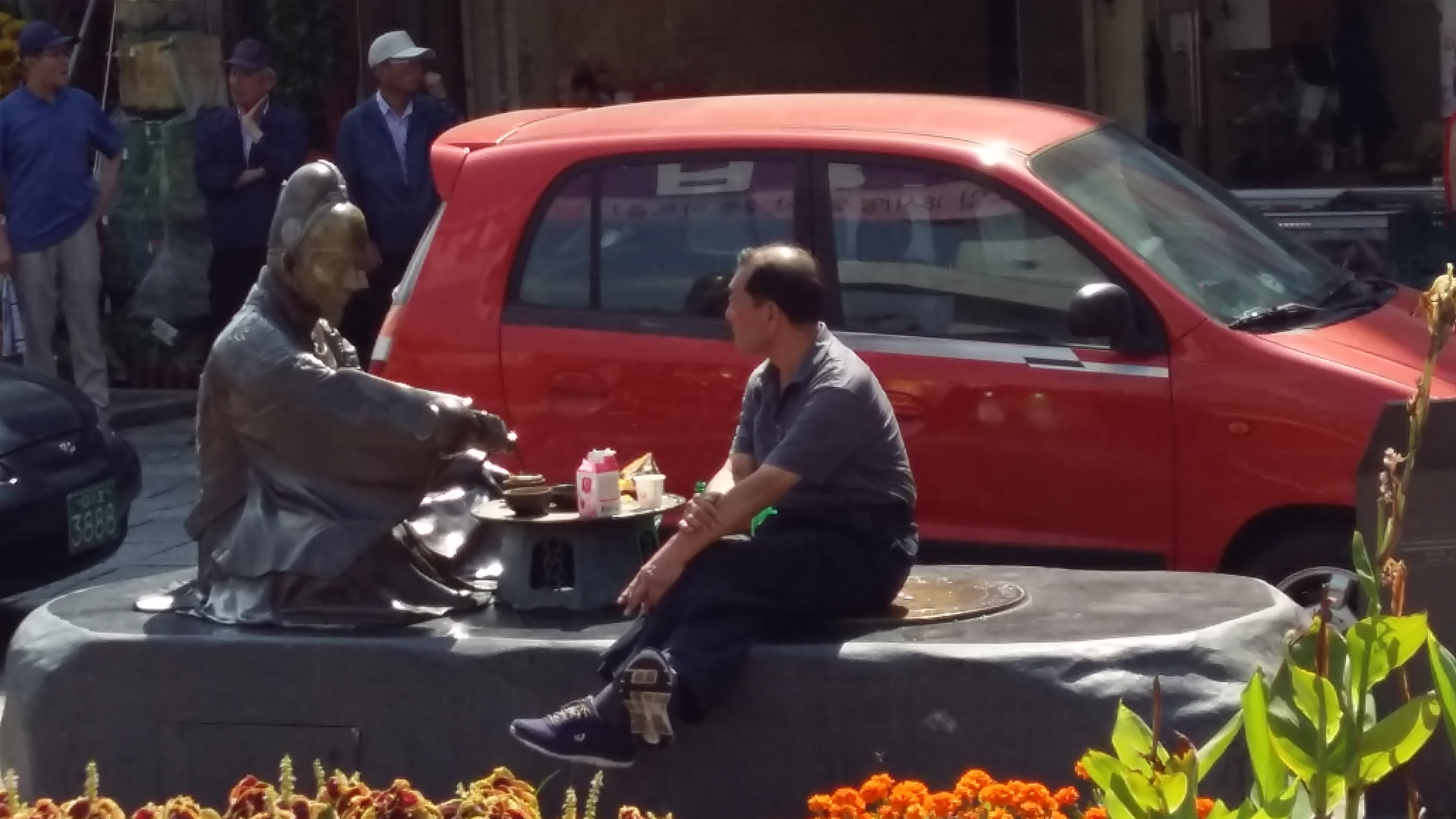
The swastika was used before the Nazis adopted it. Here, it’s used as a symbol for Buddhism.In Buddhism, people eat a meal with their ancestors, rather in the “presence” of ancestors. This is a statue in Suwon where I noticed a man eating his lunch.
Video Teleconferencing (VTC) is how meetings take place when the attendees aren’t located in the same town. In the case of my command, the units are spread all over the world so in addition to holding meetings via VTC, they’re also spread all over the clock. For the meetings to take place during normal business hours where the headquarters is, they have to take place either very early or very late in some parts of the world where we dial in from.
We had one of those VTCs tonight. For it to take place at 0700 where the command is (they did come in a bit early) it had to take place at 2000 here in Korea. That’s not too late, but when you figure on a two-hour meeting, it begins to get late.
Here’s a picture of the VTC screen before I was connected to the VTC. That’s me, what those on the other end would see.
Complicating the distance and time are the occasional technical problems which occur from time to time, which happened tonight. I was pulled into the VTC about 35 minutes late and my battalions down at Camp Humphreys didn’t get pulled in at all so I and my battalion chaplains connected telephonically, even though they weren’t on the VTC. Since they weren’t on the VTC, I texted them a picture and they sent me back this one, clearly excited to be there (or excited they were excluded from the VTC!):
My three battalion chaplains and one of the chaplain assistants at Camp Humphreys
Of course, I had to send one back:
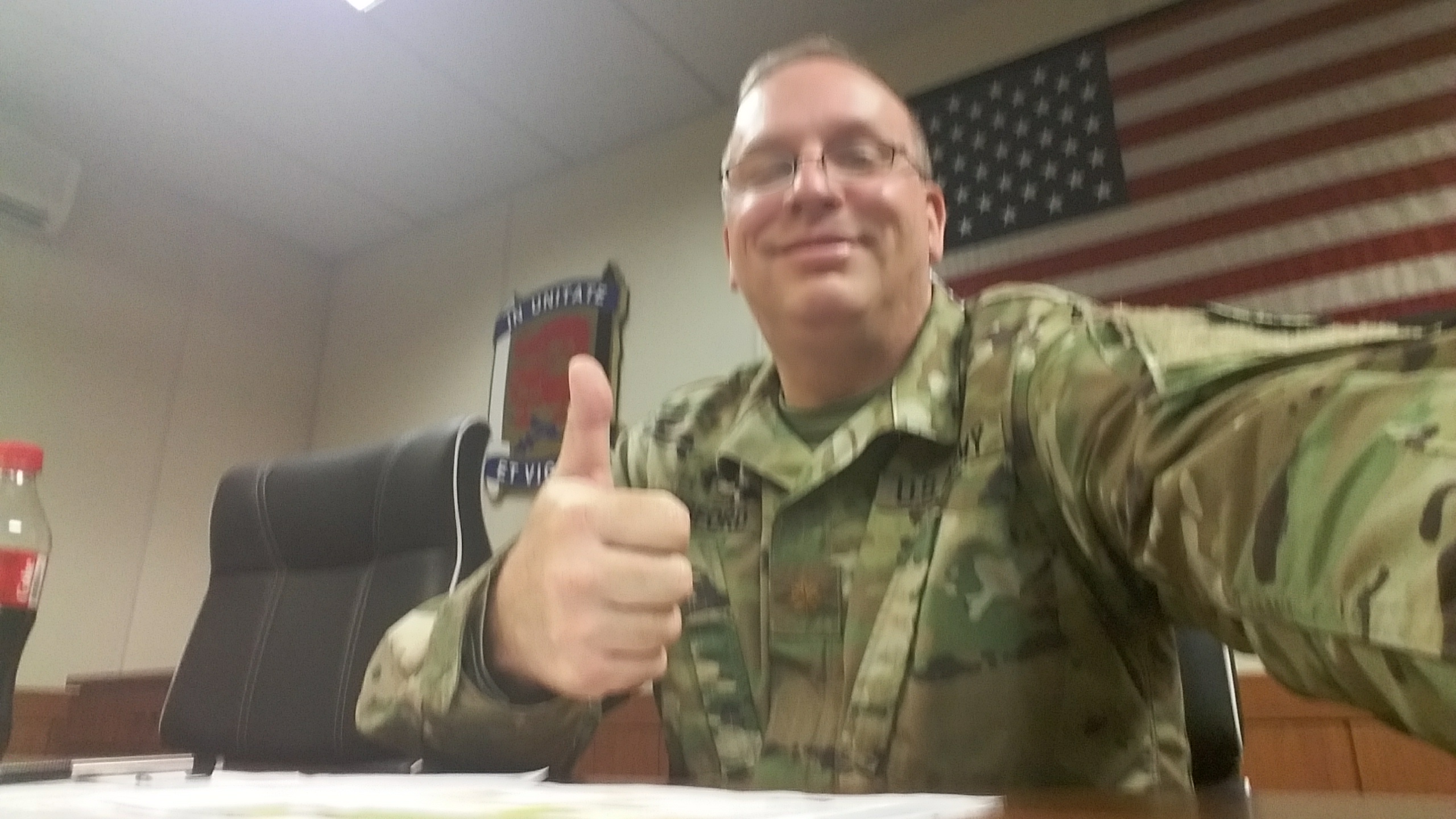
Me in our VTC/Conference Room
So even with the VTC complications, we still had a good time -from a distance- while benefiting from hearing from our higher-headquarters chaplain team. Hopefully the next VTC will have fewer technical difficulties…or maybe it’s the technical difficulties that make them more fun!
I recently reviewed a Turkish restaurant in Pyeongtaek, Nazar Kebab. Today I went with a couple of chaplain friends to a Turkish place in Itaewon, Mr. Kebab. It’s just a few blocks up the main road in Itaewon, on the right. On the way there, we passed 3 or 4 other Turkish restaurants that looked good, but we continued on to Mr. Kebab. It’s a small restaurant, with enough seats for about 25, though when we were there, there was plenty of room.
Outside of the restaurant is a Turkish Ice Cream stand, similar to the one I got ice cream from on Sunday, and wrote about in my post about Yeon Deung Hoe. I didn’t get ice cream today, though I was tempted with the baklava, but I passed on it too (for now). They also had chocolate baklava, which doesn’t appeal to me, but I’m sure my wife would have chosen it.
I ordered the Turkish Lamb Kebab on tortilla bread. It came with the roasted lamb, lettuce, tomato, onion and the special sauce (don’t think McDonald’s). I’ve got to say, I didn’t think I’d find a better one than what I get at Nazar Kebab in Pyeongtaek but Mr. Kebab came through. I think it may be that there was more sauce on this one, which gave it a bit more flavor without loosing the taste of the lamb.
The menu includes a number of items that look really good. You can choose from fish, chicken or lamb options; choices of breads (tortilla, baguette), rice, falafels with many different combinations. For sides, you can order potato fries, onion rings or cheese sticks. For desert, you can choose baklava, as I already mentioned, but also Turkish Delight (which I’ll go back for after my weigh-in in a couple of weeks!), Turkish Ice Cream or yogurt. There’s also the normal selection of drinks, teas and coffees.
It was a great lunch with Sean and Jorge, two chaplain friends. Notice the Turkish-style tiles on the wall.
As it turns out, Mr. Kebab has two locations in Itaewon and apparently is affiliated with Kervan Turkish Restaurant (which seems to be more “upscale” than Mr. Kebab), with 3 locations; Kervan Bakery and Dessert Bar and Sultan Turkish Kebab House which looks to have a different variety of Turkish dishes than Mr. Kebab.
Friends from the service I worked in at Fort Leonard Wood showed up at my service in Yongsan (which was a nice surprise!) and invited me to go downtown with them to the Yeon Deung Hoe or Lotus Lantern Festival. This was the main weekend of a month-long celebration of the Buddha’s coming into the world (birthday). Attending the festival, at least for me, wasn’t an act of honoring or worshiping Buddha but rather of observing the cultural significance of Buddhism in Korea.
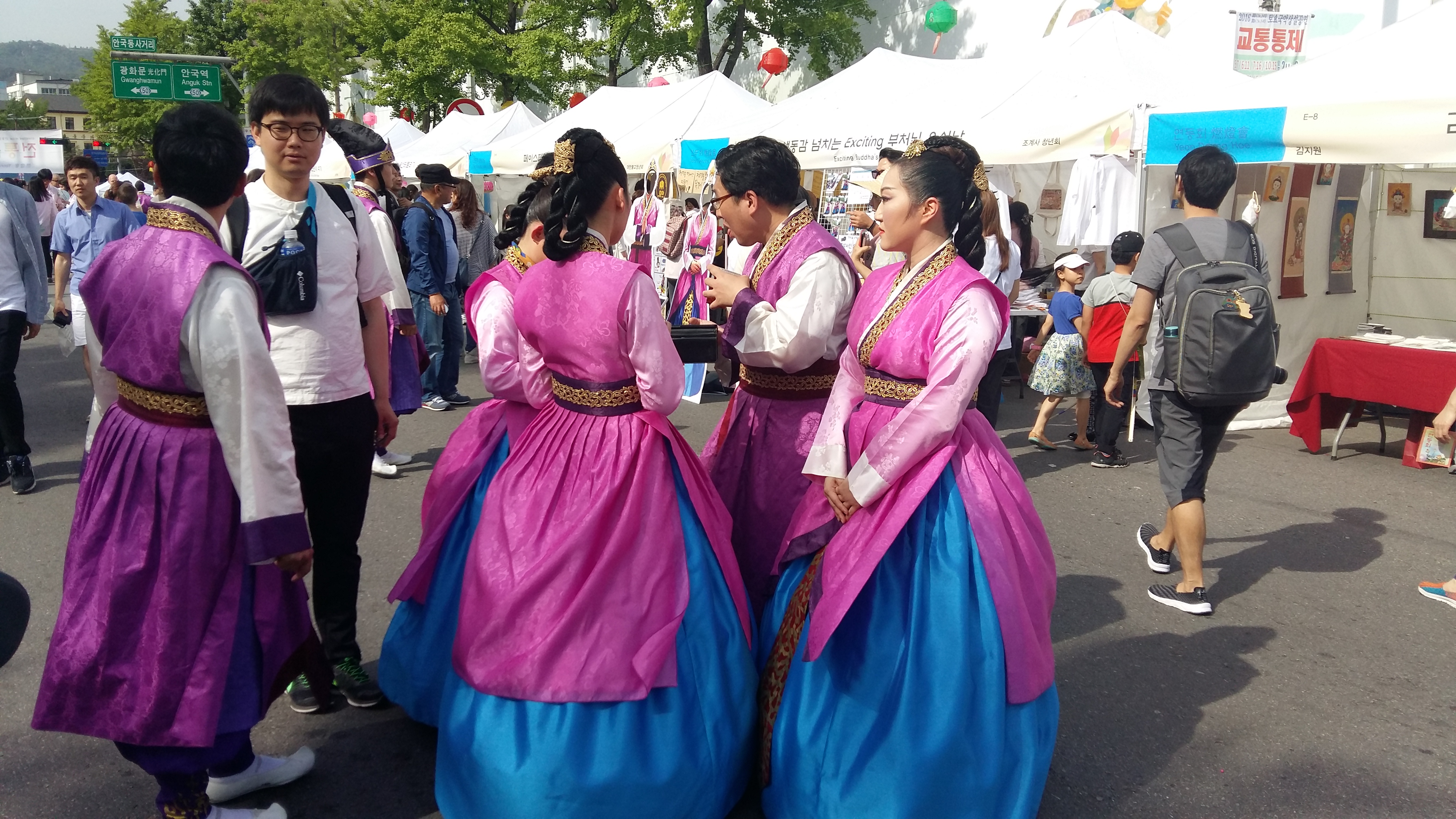
There were several downtown streets closed to vehicle traffic and lined with booths sponsored by different Buddhist orders. Much like many festivals in the U.S. there were crafts for children to make, teas to taste, temple foods to sample, and various causes to support.
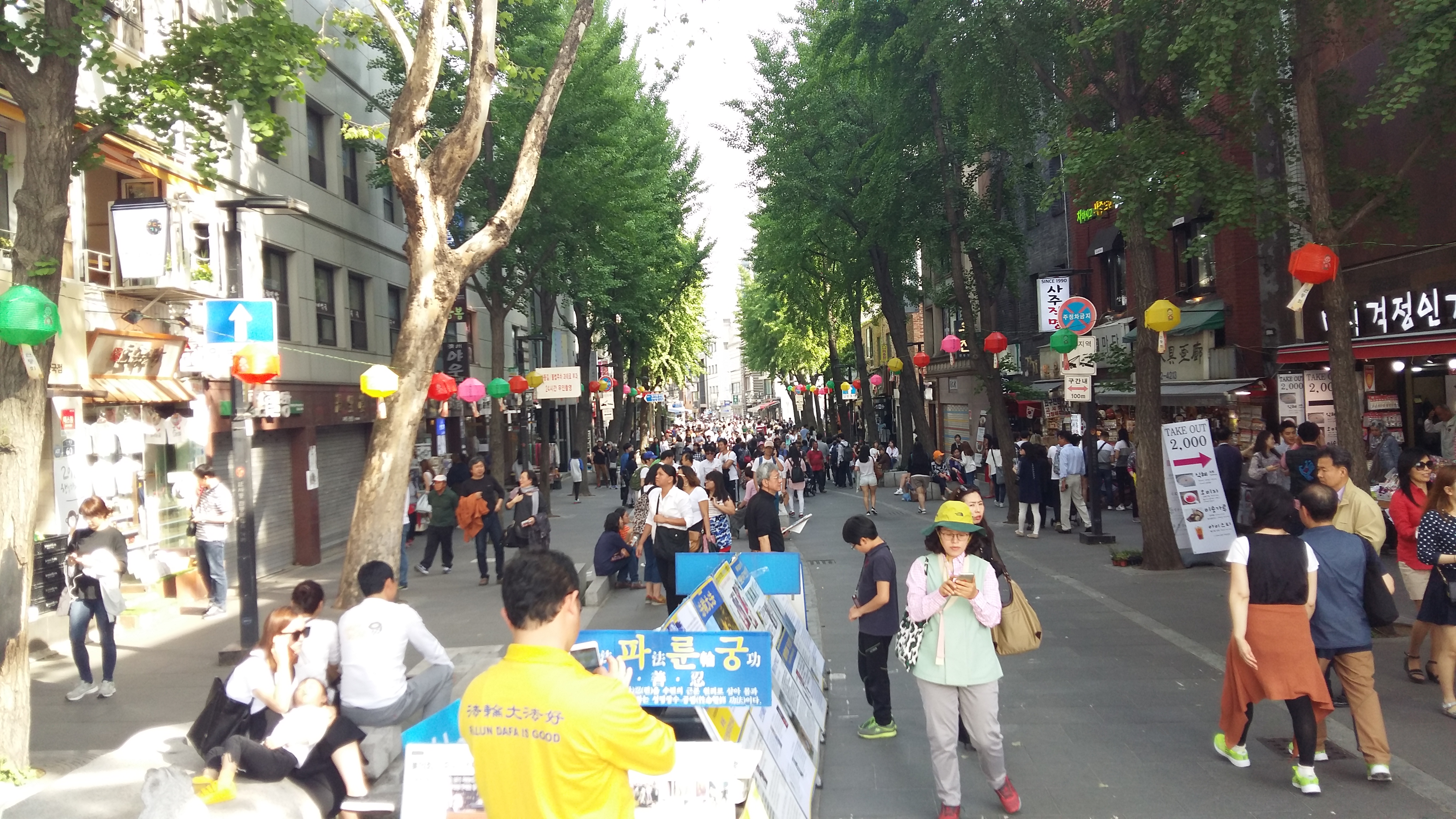
There were large crowds everywhere. The smaller streets were more crowded.
The businesses and kiosks that normally line the streets were also open, providing a variety of Korean foods, arts and crafts, souvenirs and other special and routine products for sale.
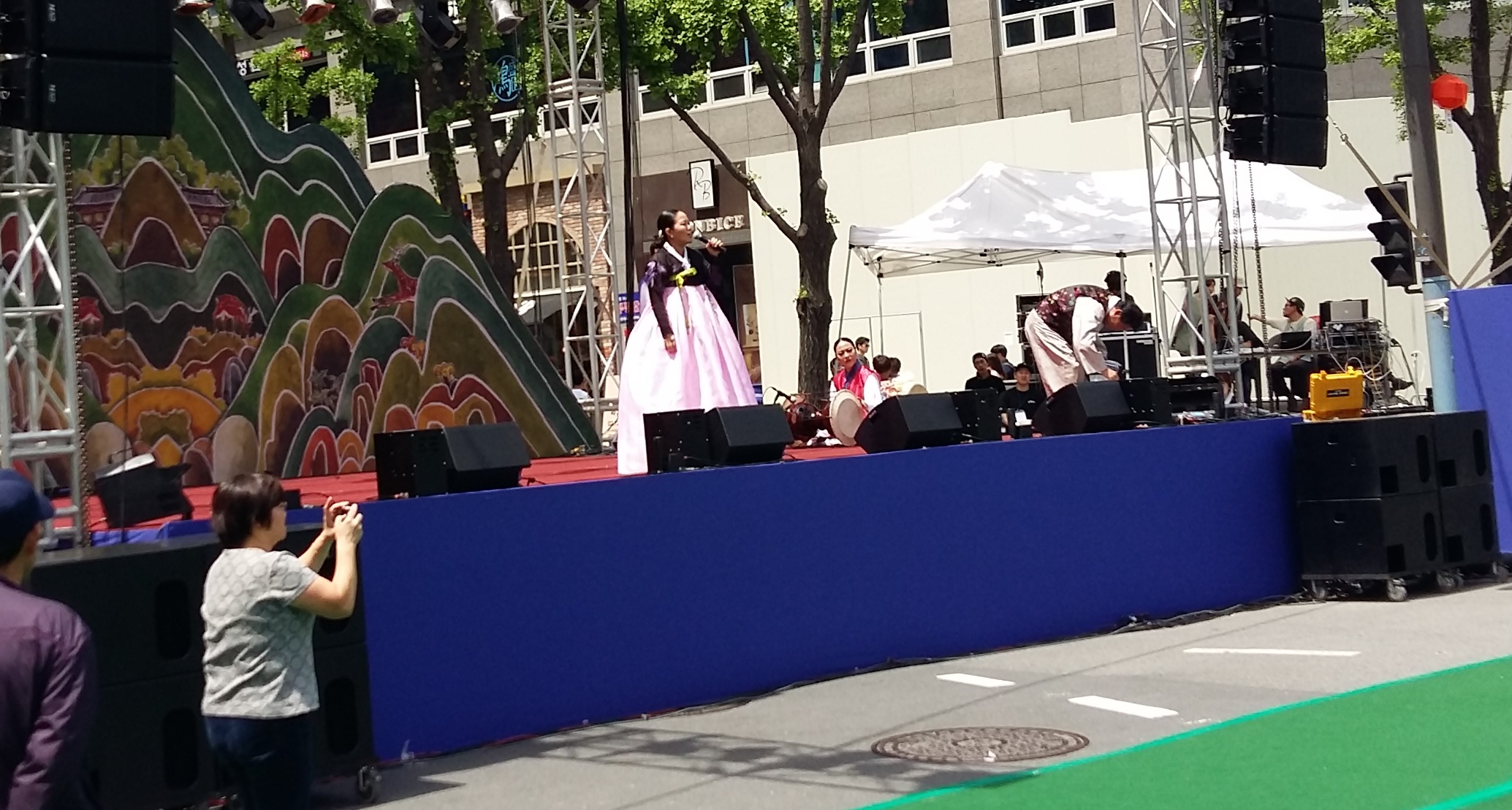
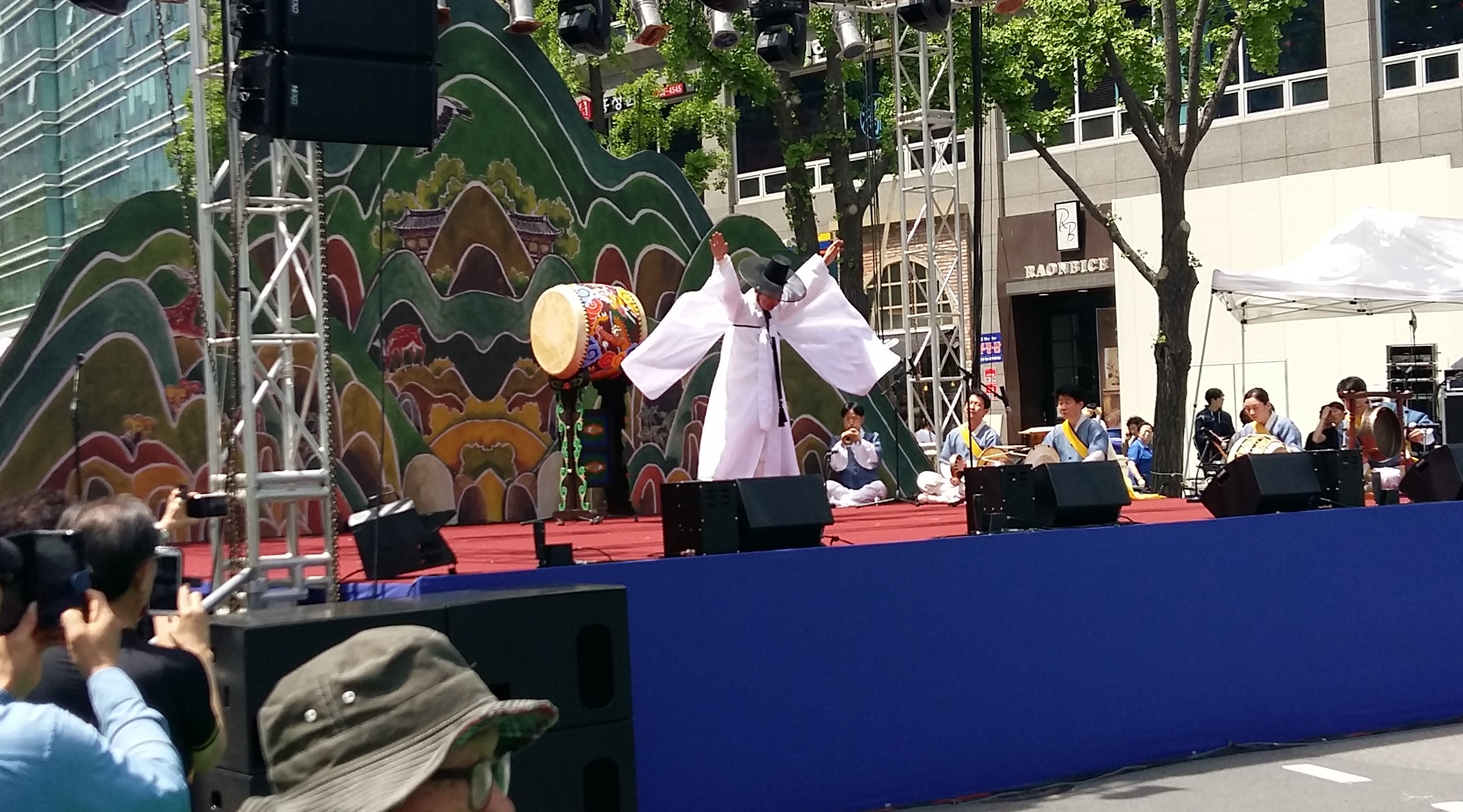
There was a main stage area in the center of the festivities where traditional Korean and, I assume, Buddhist performances were staged.
A Korean woman singing, with what resembled a conga line, though was probably supposed to be a dragon.
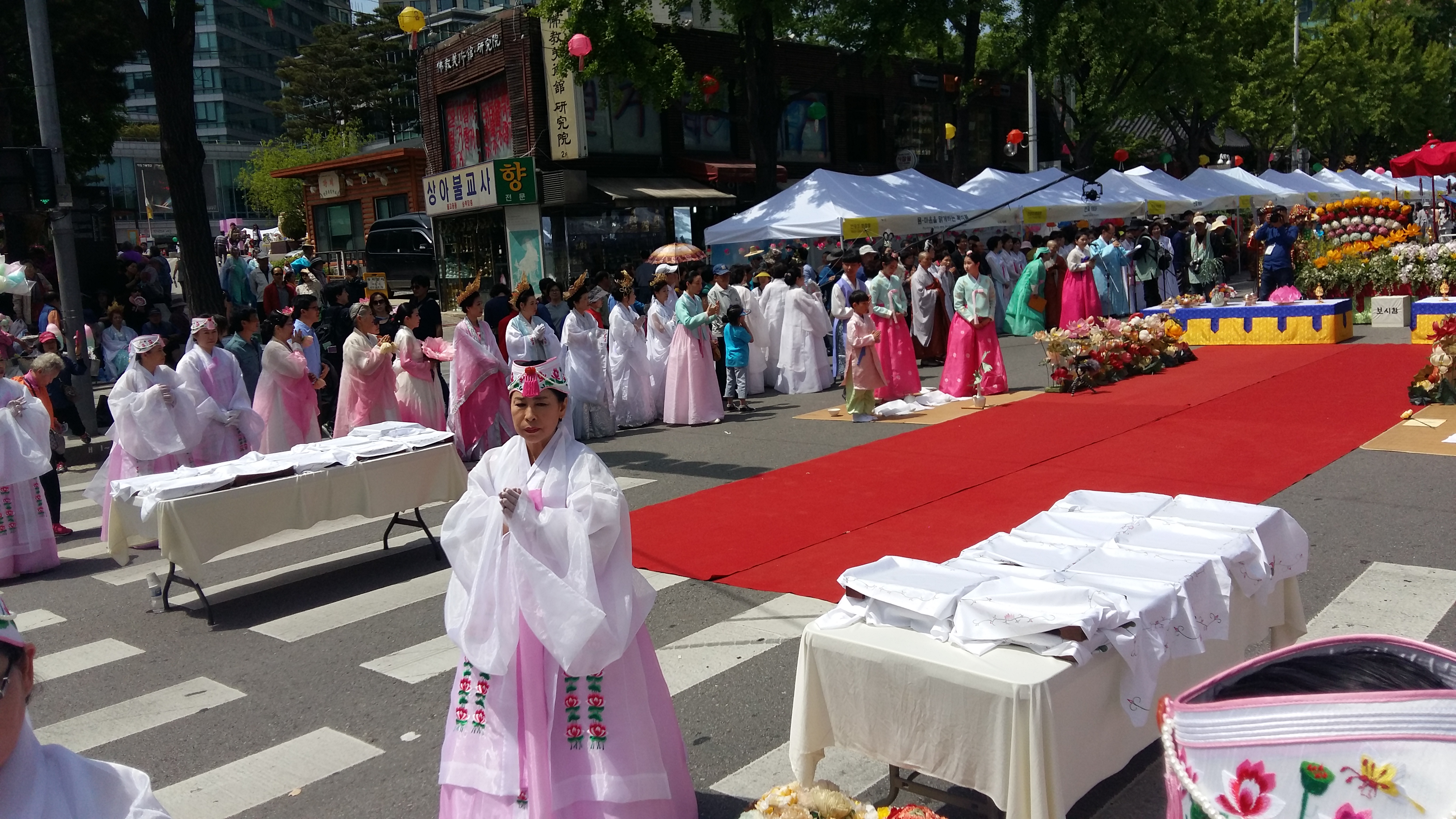
Along the street, there were various ceremonies going on; some for people to watch, others for people to participate in.
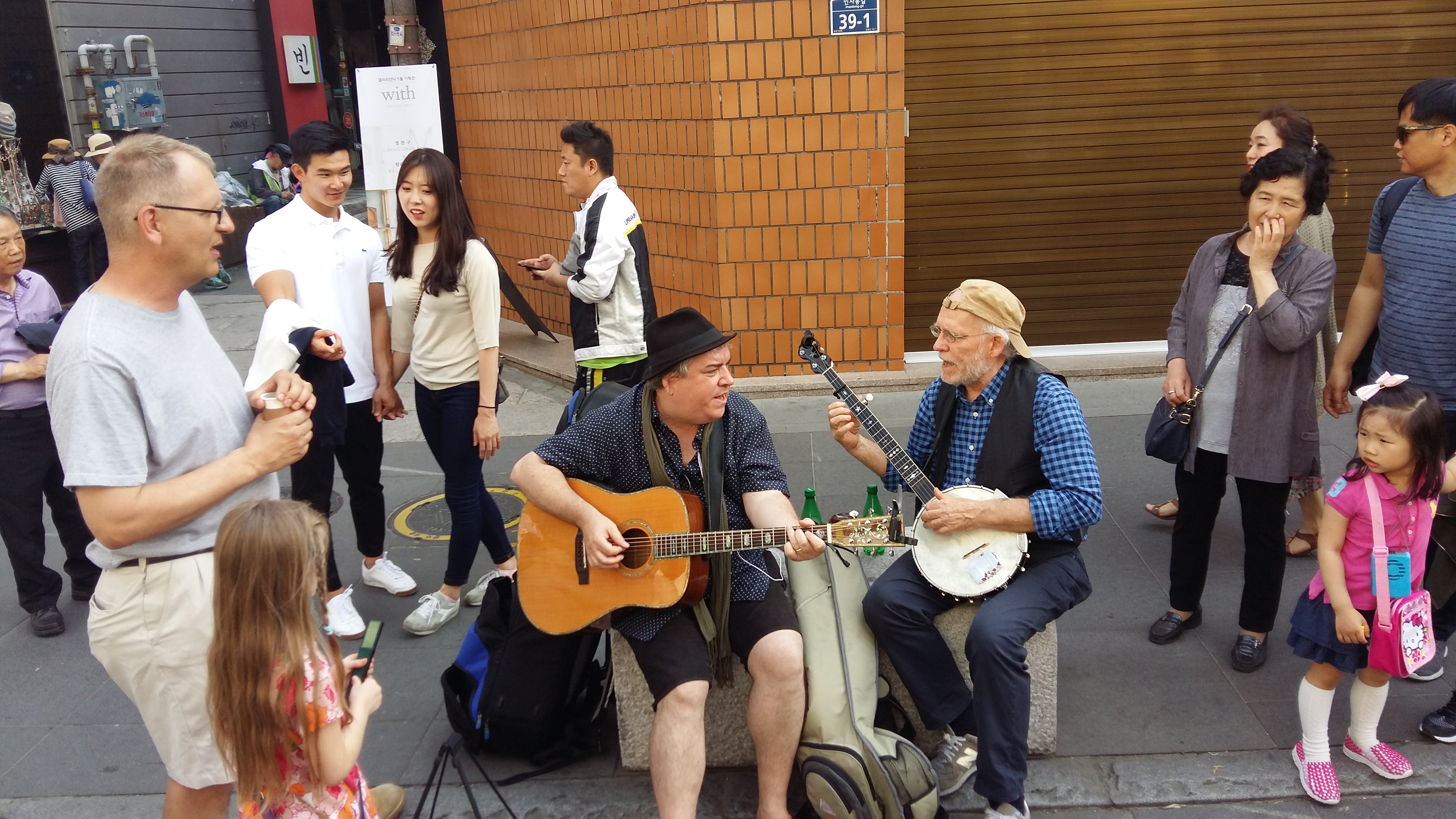
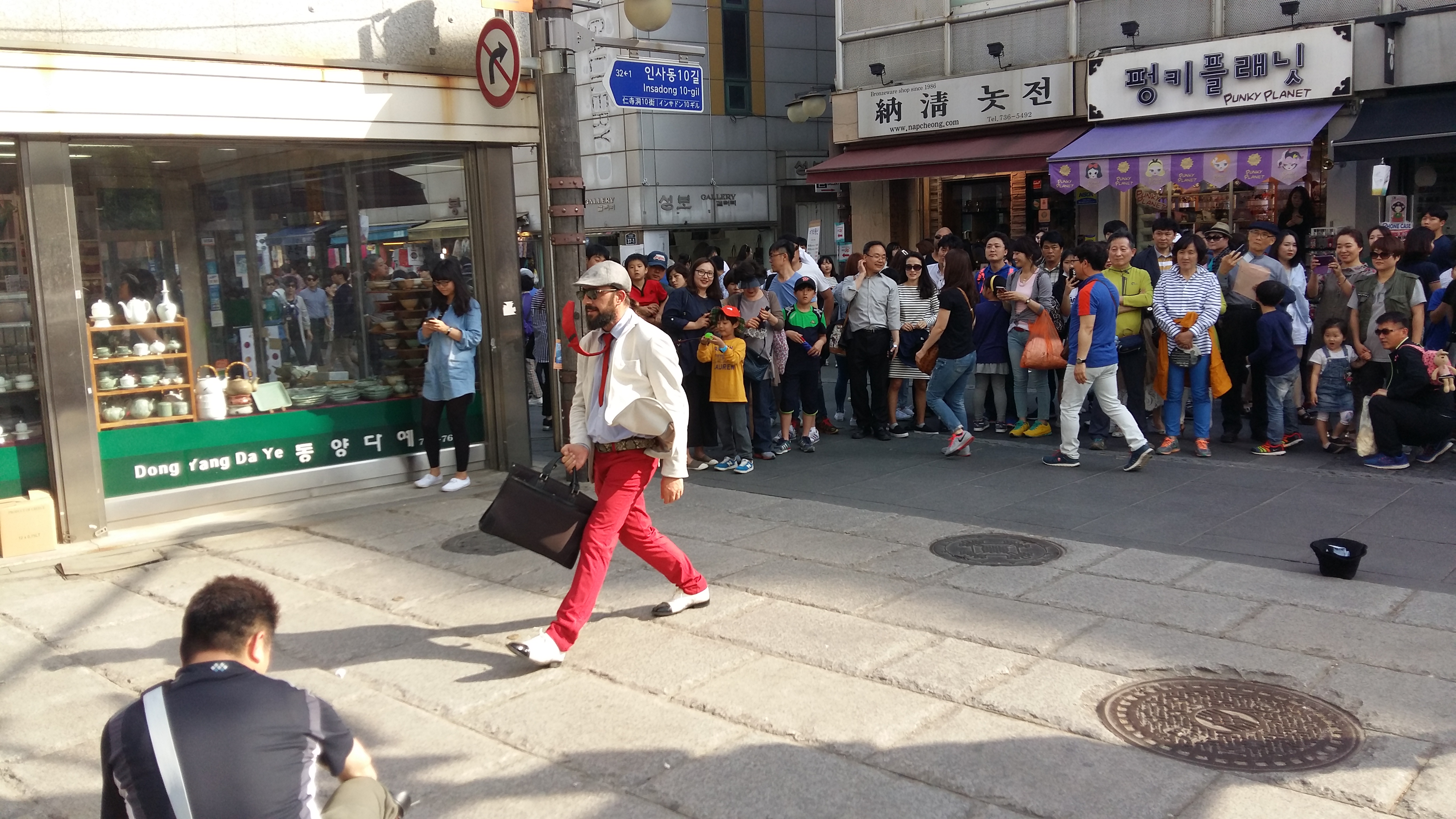
And then there were street performers…
A couple of expats playing bluegrass.This guy stands statute-still until someone puts money in his hat or approaches him.
There were also artists…
…and others needing assistance.
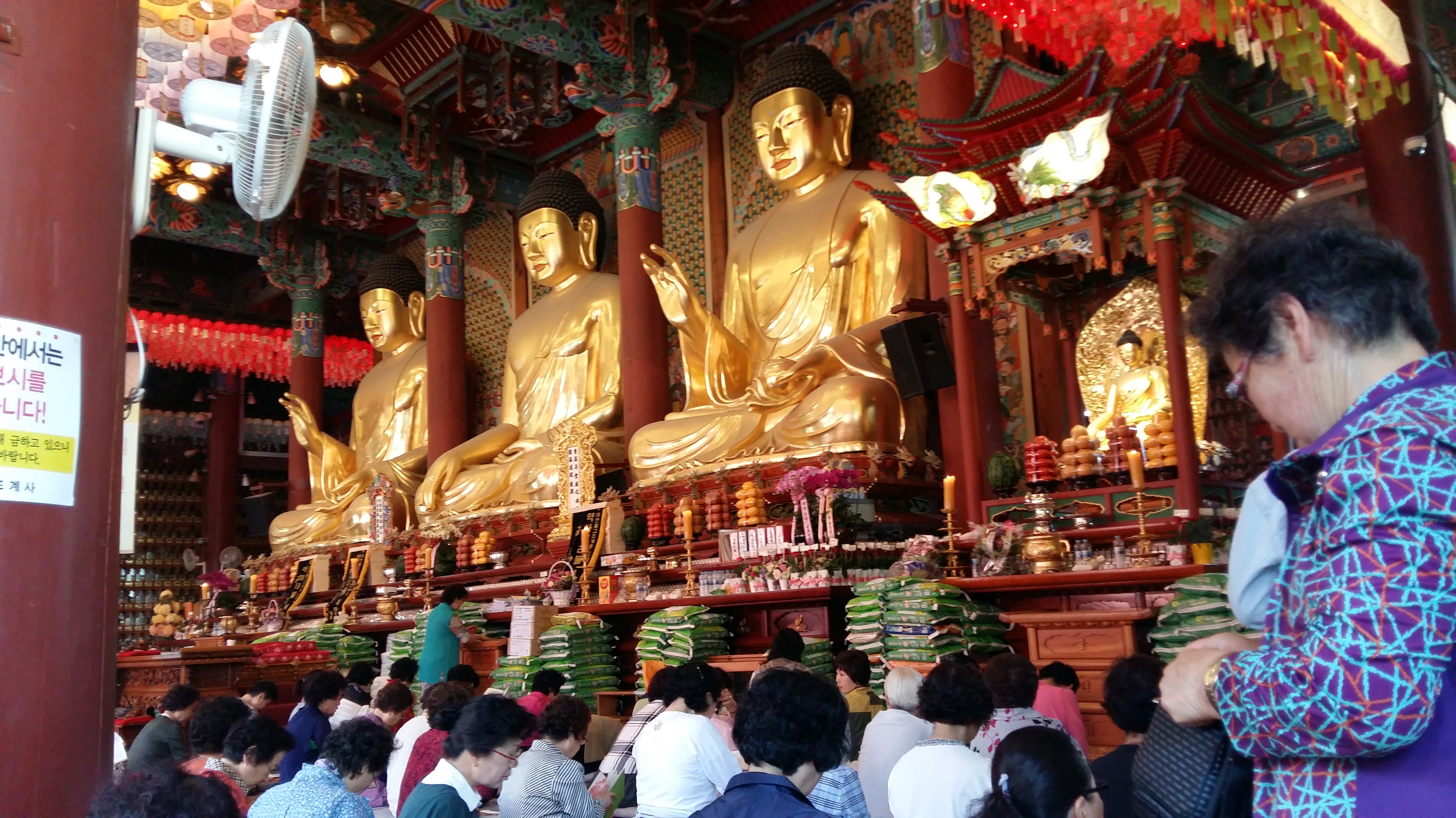
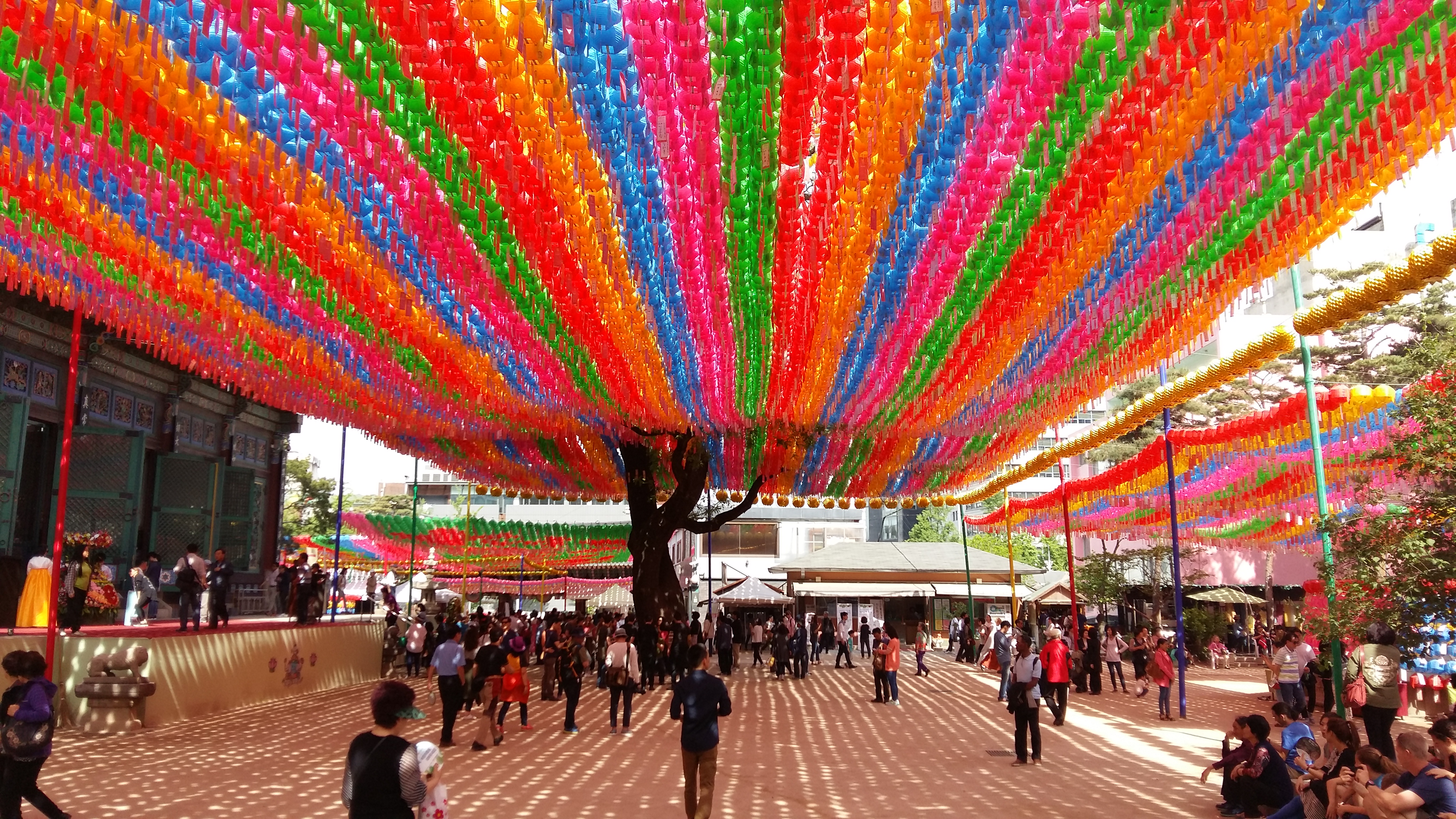
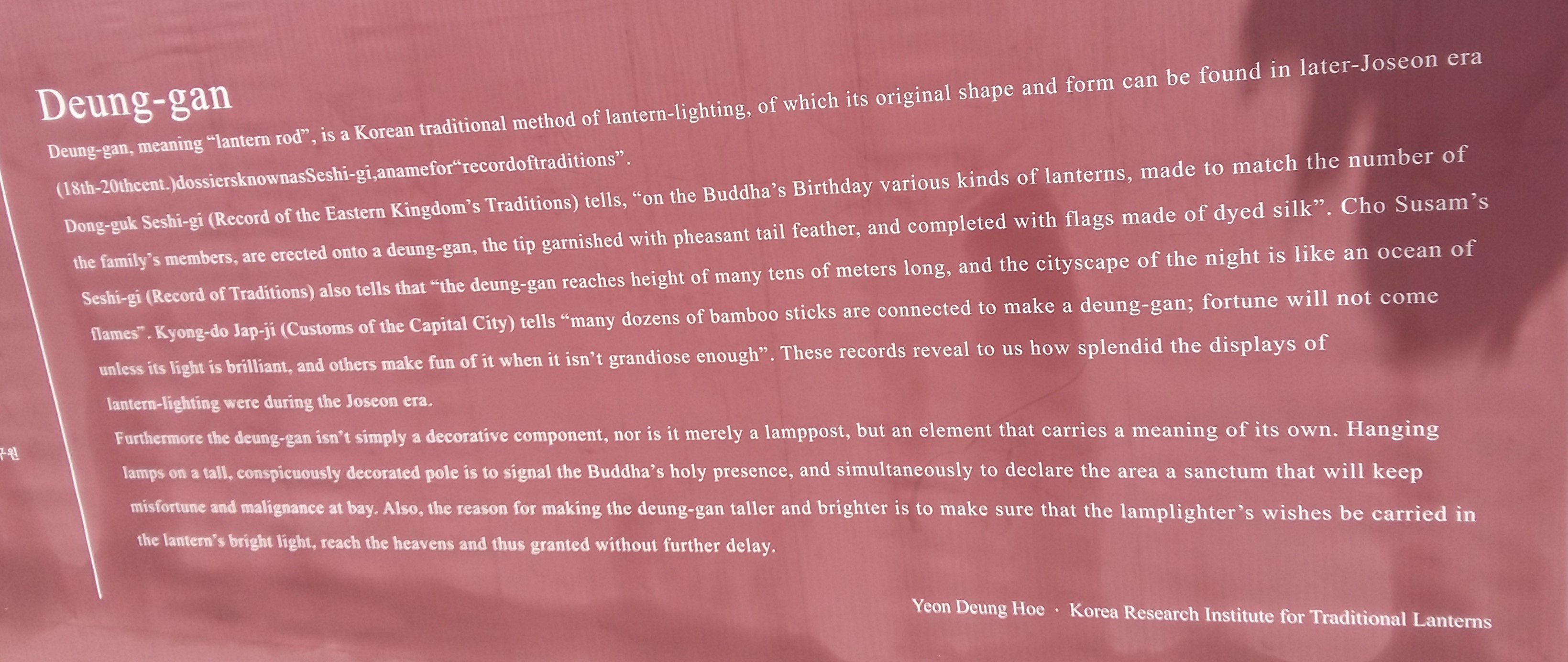
The festival was in the neighborhood of the large Jogye-sa Temple, which seemed to be a focal point of the festivities where people gathered in the temple to pray, participate in the Ceremony of Bathing Buddha and have their prayer requests attached to paper lanterns and hung over the Temple Square.
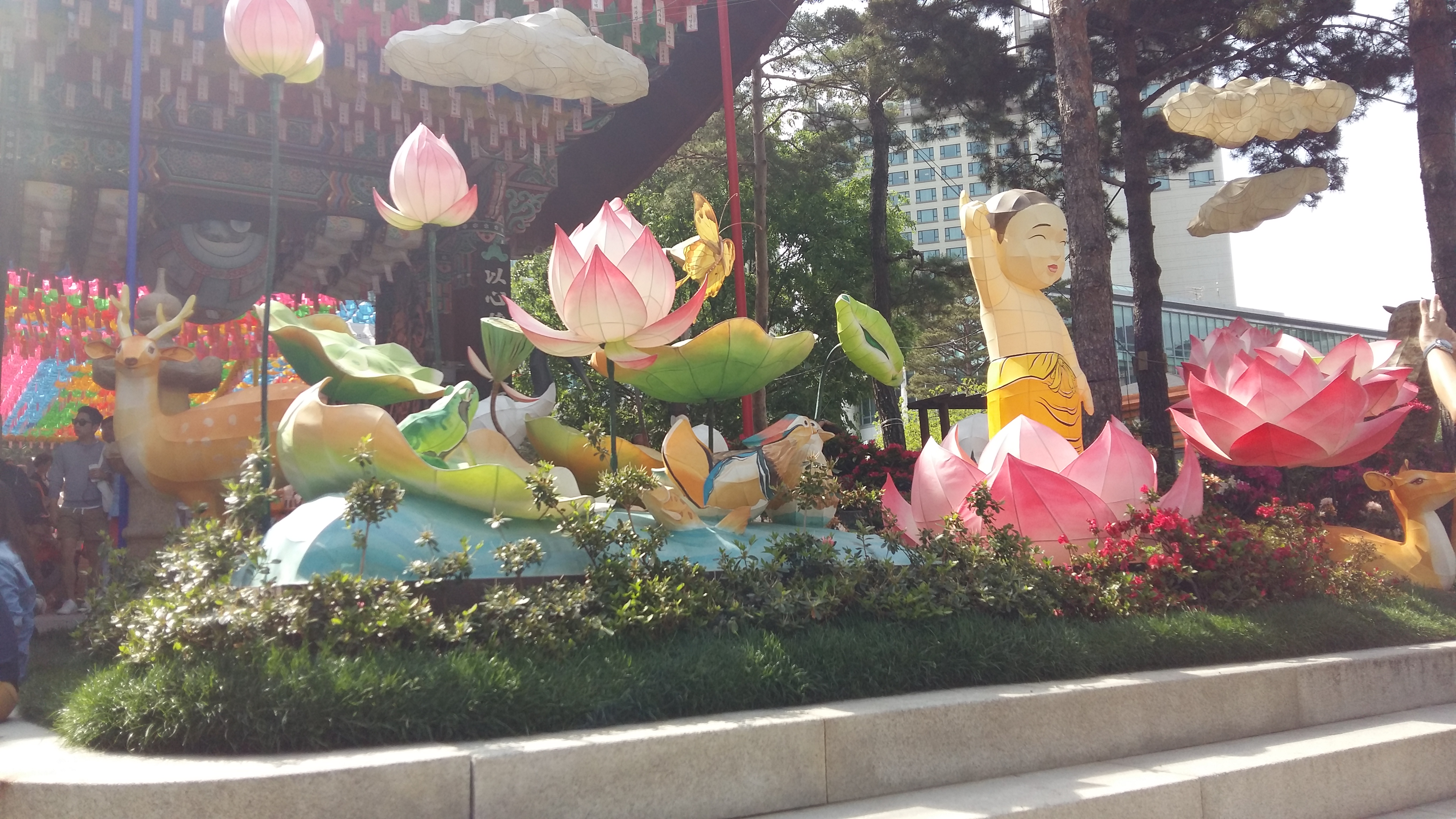
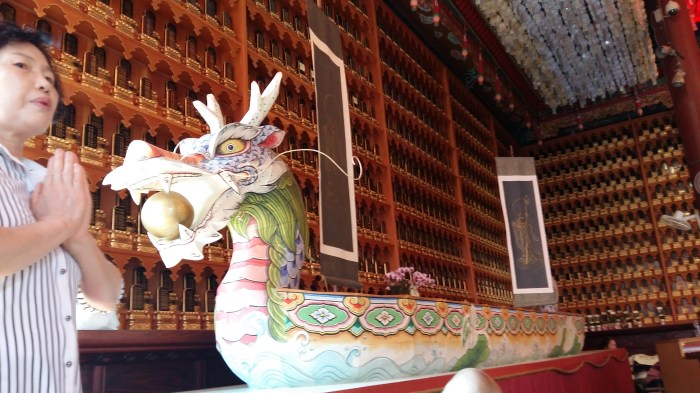
Decorations made of paper on the temple groundsThe Jogye-sa TempleInside the Jogye-sa Temple
Inside The Jogye-sa TempleNice detailed painting on the outside of The Jogye-sa TempleNice detailed painting on the outside of The Jogye-sa TempleNice detailed painting on the outside of The Jogye-sa TempleNice detailed painting on the outside of The Jogye-sa Temple
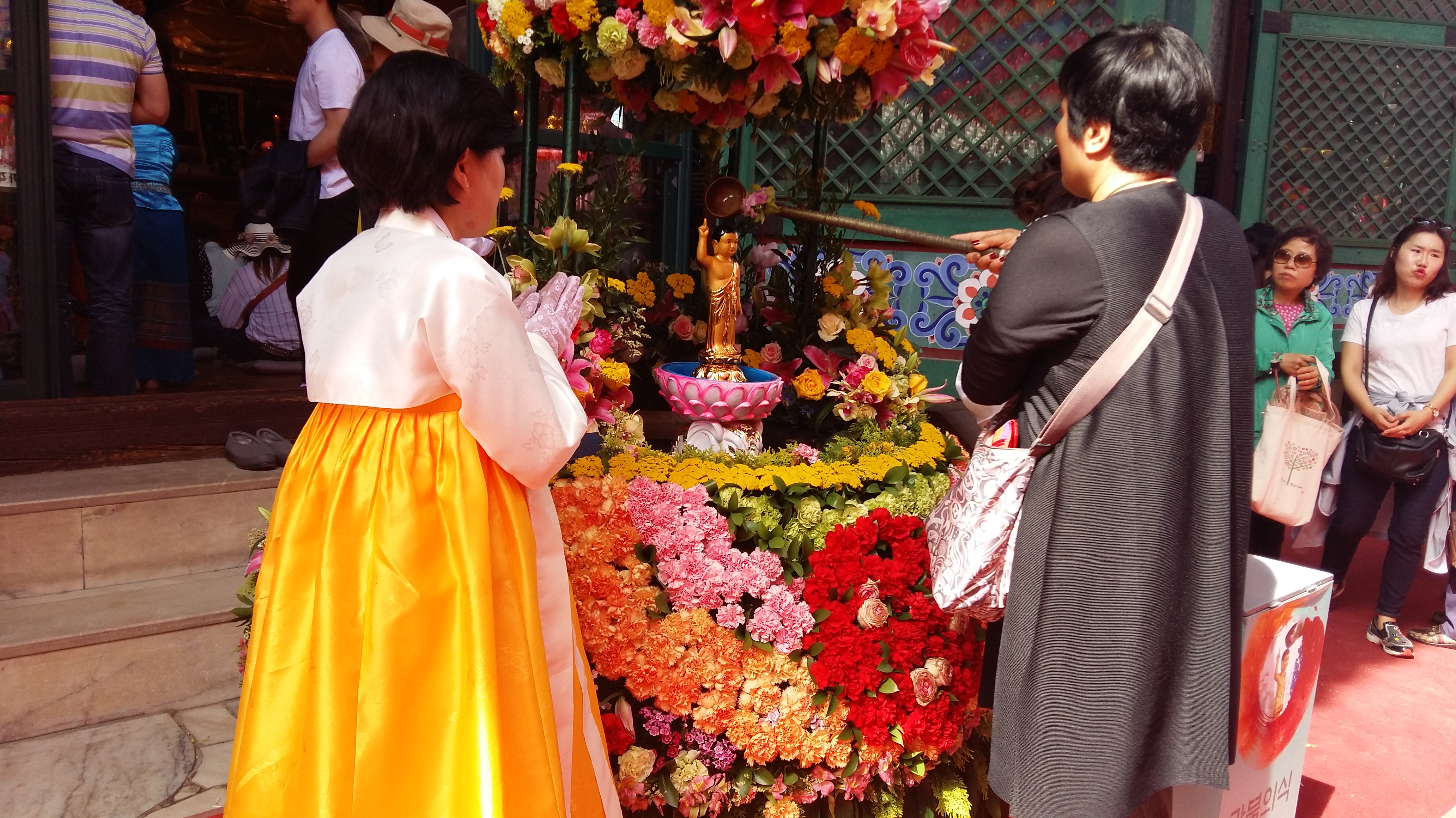
According to Buddhist, The Ceremony of Bathing Buddha is a ritual to improve happiness and peace of mind. The sign outside of the temple states the proper way of bathing Buddha is to fill the ladle and pour water over the small Buddha statue three times. While pouring the water, the participant is to say during the 1st wash, “May I eliminate all evil thoughts.” During the 2nd wash, “May I cultivate good deeds.” And during the 3rd wash, “May I help save all living beings.”
A Buddhist adherent participating in the Ceremony of Bathing BuddhaThere were hundreds, perhaps thousands of lanterns hanging all over the temple grounds with prayer requests from Buddhist adherents (and they’re pretty…)Some of the floats from the parade the night before, on the temple grounds.Some of the floats from the parade the night before, on the temple grounds.
All over the festival area there were lanterns made of hanji, which is a traditional handmade Korean paper made from mulberry bark. Most were very unique and detailed, beautiful works of art which reminded me of the variety of kites in the U.S.
All along the streets and booths were varied and plenteous food offerings.
We passed several Turkish Ice Cream stands.The dipping and serving was very entertaining.And it was good ice creamI did NOT try the octopus on a stick!I did try a hot dog on a stick…covered in potatoes.Hot Dog and French Fries in one hand. A convenient walking food!
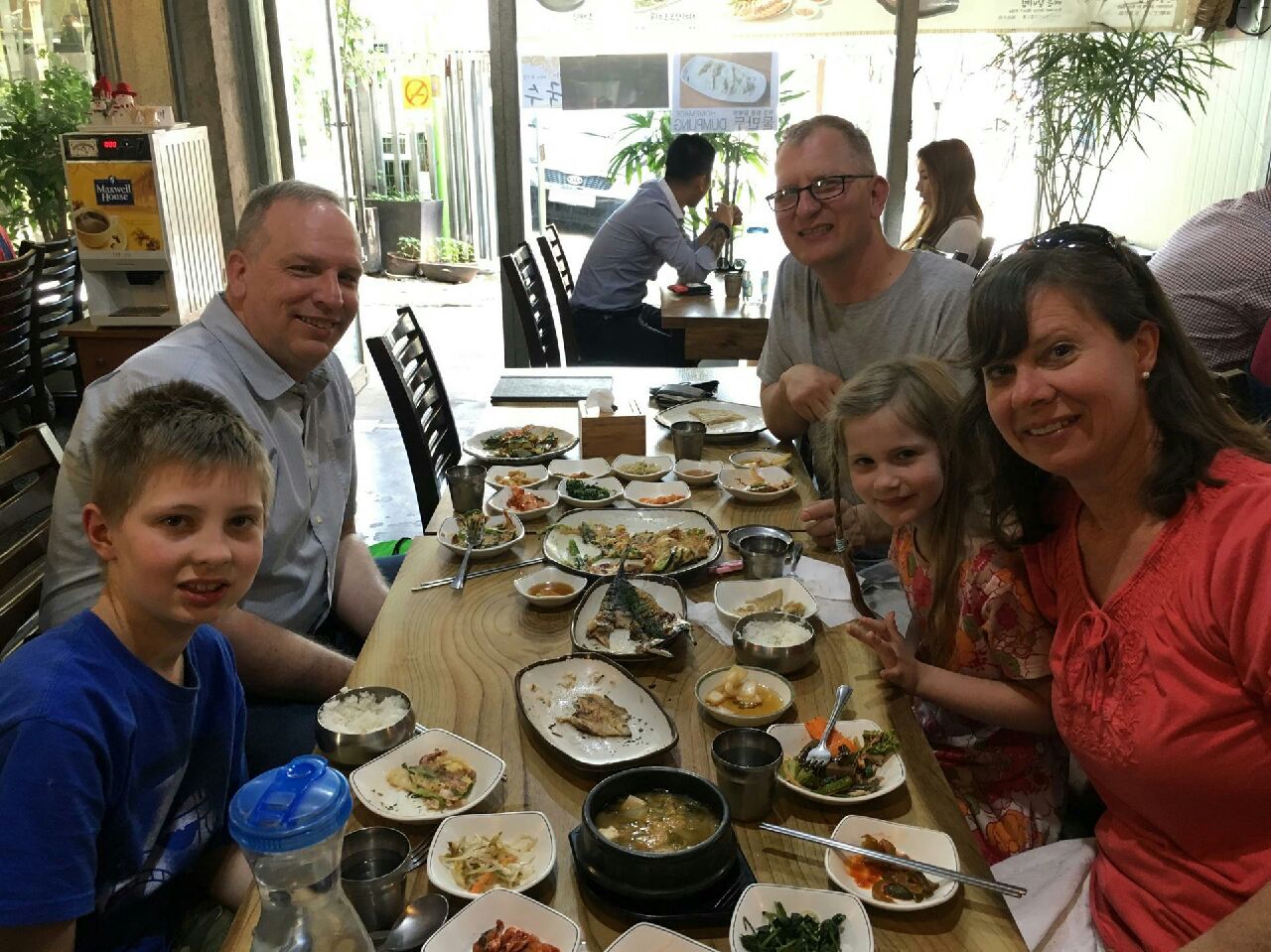
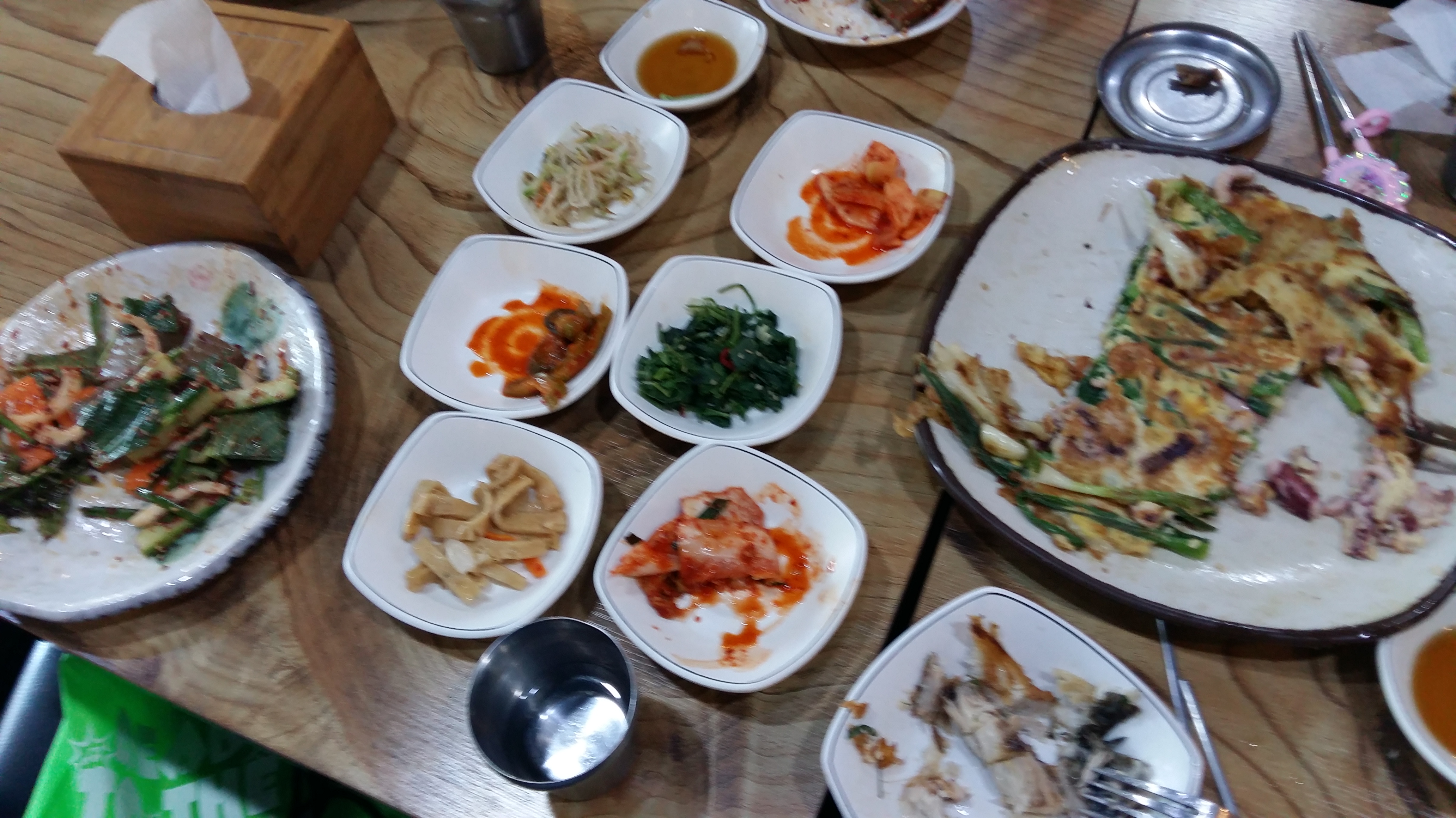
We ate lunch at a small Korean seafood restaurant where we had a good sampling of fish and pancakes.
I’m not sure of the name of the restaurant we ate at, it may say it here…… or here.Jamie and Robyn and their two children, a family I got to know at Ft. Leonard Wood who recently arrived at USAG Yongsan. We ate at a little restaurant down a few side streets near the festival.We ordered 2 or 3 different fish and a seafood pancake which turned out to be octopus.Our meal also came with the usual variety of side dishes.
.
Part of the fun of going to a festival is what you bring home. Here are a few things I picked up while walking around the area:
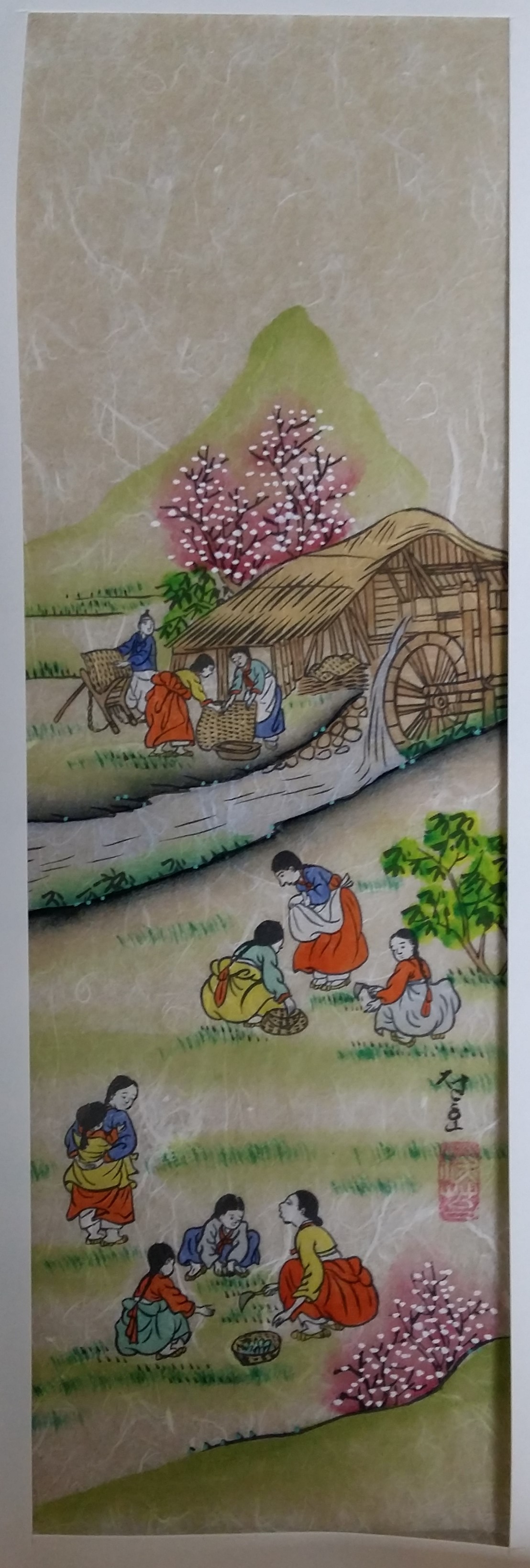
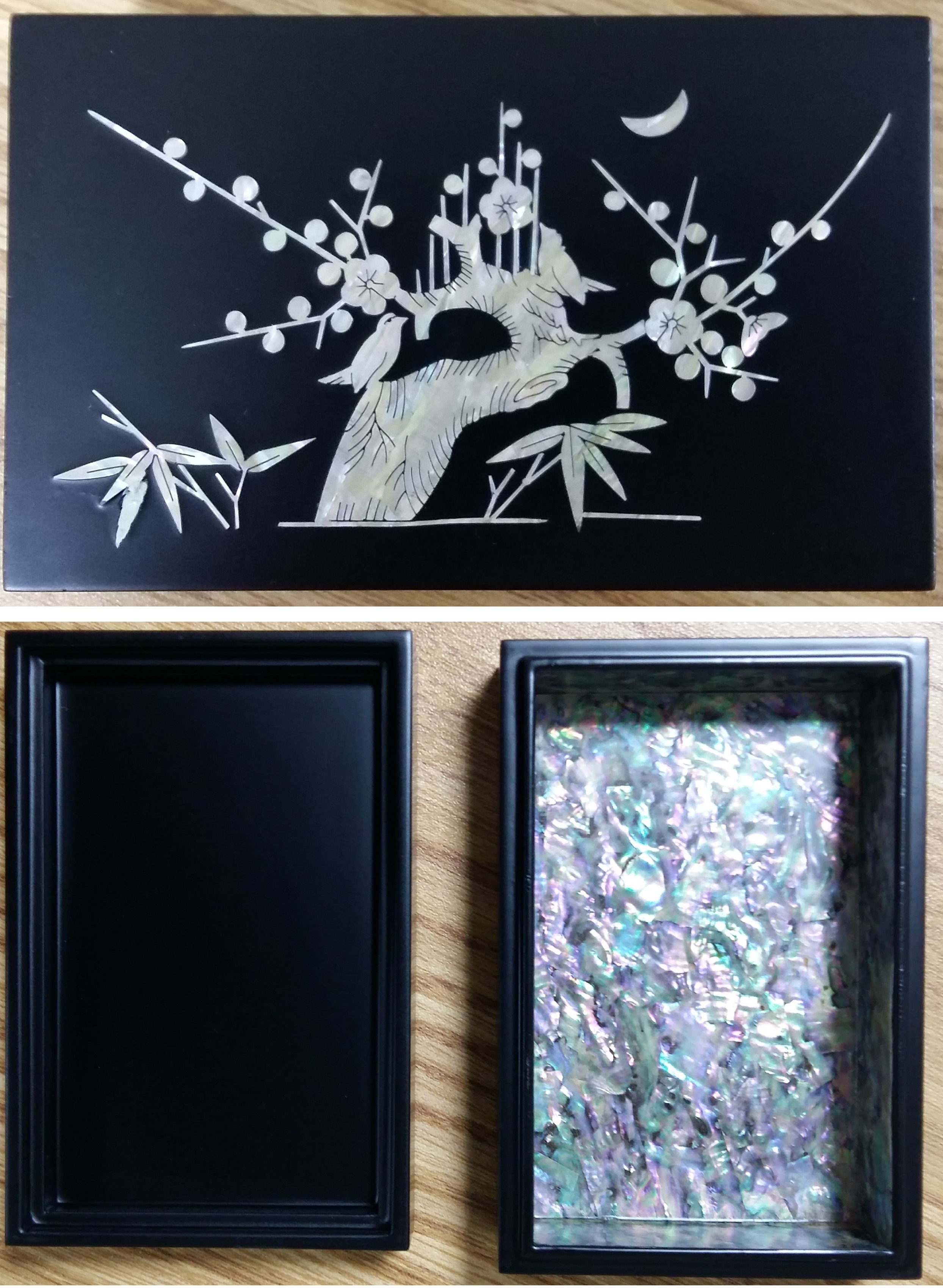
A painting of a traditional Korean village scene painted on rice paper.I picked up this box at the Temple Gift Shop. “Mother-of-Pearl (najeon or jagae in native Korean) is a highly intricate decorative technique whose tradition in Korea has been kept alive for more than a thousand years. Pearl oyster, conch, and abalone shells are filed to reveal the iridescent inner layers. Thin strips are then inlaid into a black lacquered surface. The whole thing is pained again, and then the excess lacquer is carefully filed away to reveal the brillian and translucent colors of different patterns. Thus the common expression ‘najeon chilgi,’ where ‘chil’ means ‘painting.’ Najeon chilgi is not just about shiny shells. Shell’s brillian colors come alive because of the pitch-black lacquer. Its true beauty is revealed not under bright lights, but under dim candle light or delicate sunlight seepin through Korean traditional windows covered in Korean paper ‘Light etched into darkness.’ Najeon chilgi is a thousand-year-old light of nature, the most intricate and beautiful of traditional lacquer-ware, and an applied art that represents Korea’s beautiful traditional aesthetics.”
The Temple Gift Shop had these paper models of the Four Heavenly Kings for sale and one of the booths in the festival were giving them away. I got the free ones, though I came home with just 2 of the Four Heavenly Kings. According to Buddhism, The Four Heavenly Kings are “gods” who watch over the four cardinal directions of the world. They are said to be the protectors of the world who fight evil and able to command a legion of supernatural creatures to protect the Dharma.
A near life size stand up of one of The Four Heavenly Kings on the complex of Jogye-sa Temple.
Two of the Four Heavenly Kings at the Jogye-sa Temple complex.
Wherever you go in the military, a tradition that you experience is the military ball. Often annually, sometimes before or on return from deployment; units, schools and commands take the opportunity to celebrate the accomplishment of their mission, their safe return from combat, or continued alliances with coalition partners.
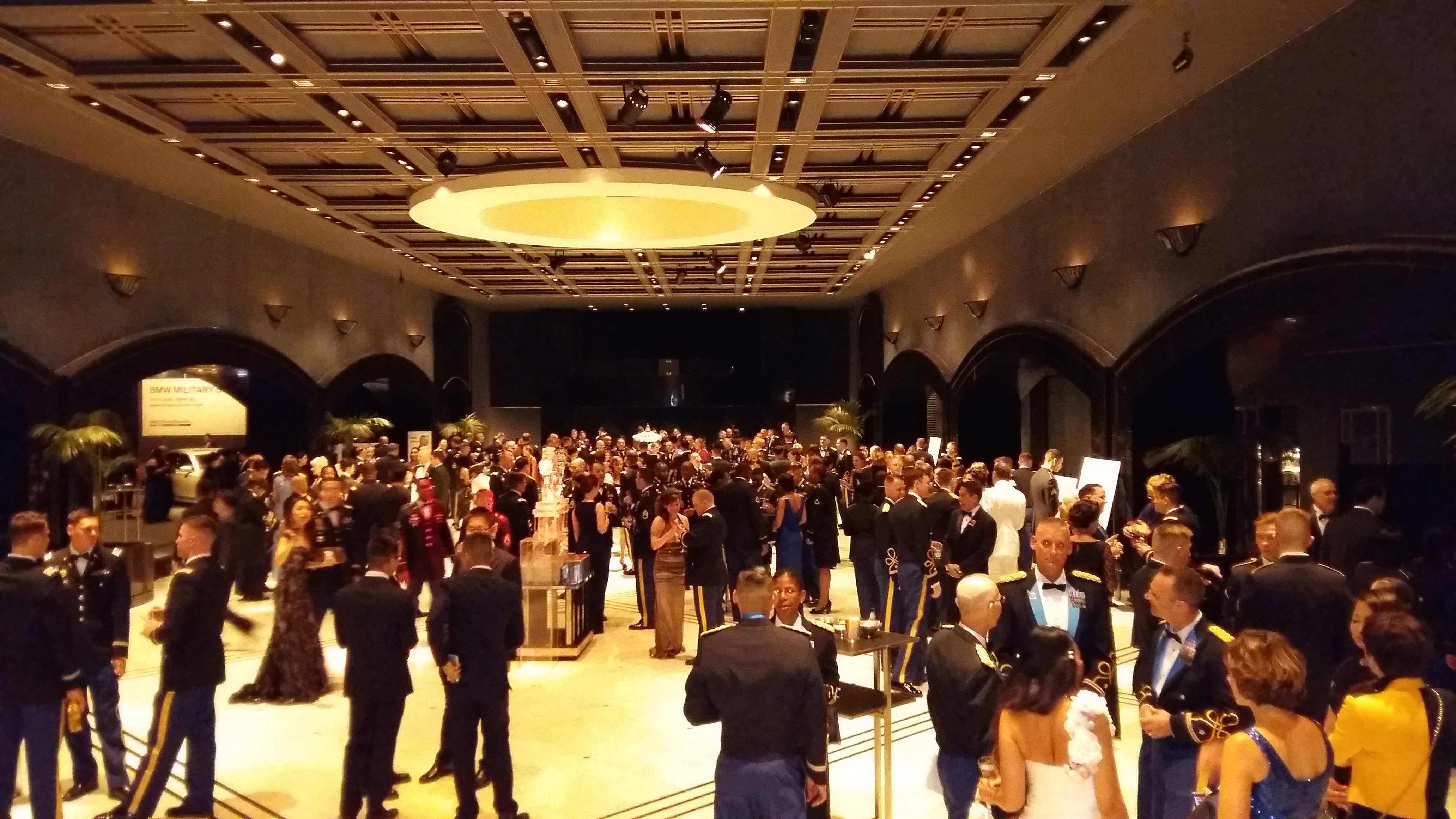
Tonight, my brigade sponsored the ball for the Intelligence community in South Korea, with guests and participants from both U.S. and ROK forces. With over 700 in attendance it was quite the event. As with most ceremonies and events, as the brigade chaplain I was called upon to pray…twice. Here are some pictures from the evening (though a combination of the lighting and using my phone/camera mean they’re not that great):
Walking into the ballroom, the crowd is already mingling.
.
A “Red Dragon” ice sculpture. My brigade is called the “Red Dragons”
.
The tables were all set nicely (I only drank the water)
.
A number of Soldiers, from the U.S. and ROK, received the “Knowlton Award,” given by the Military Intelligence Corps Association.
.
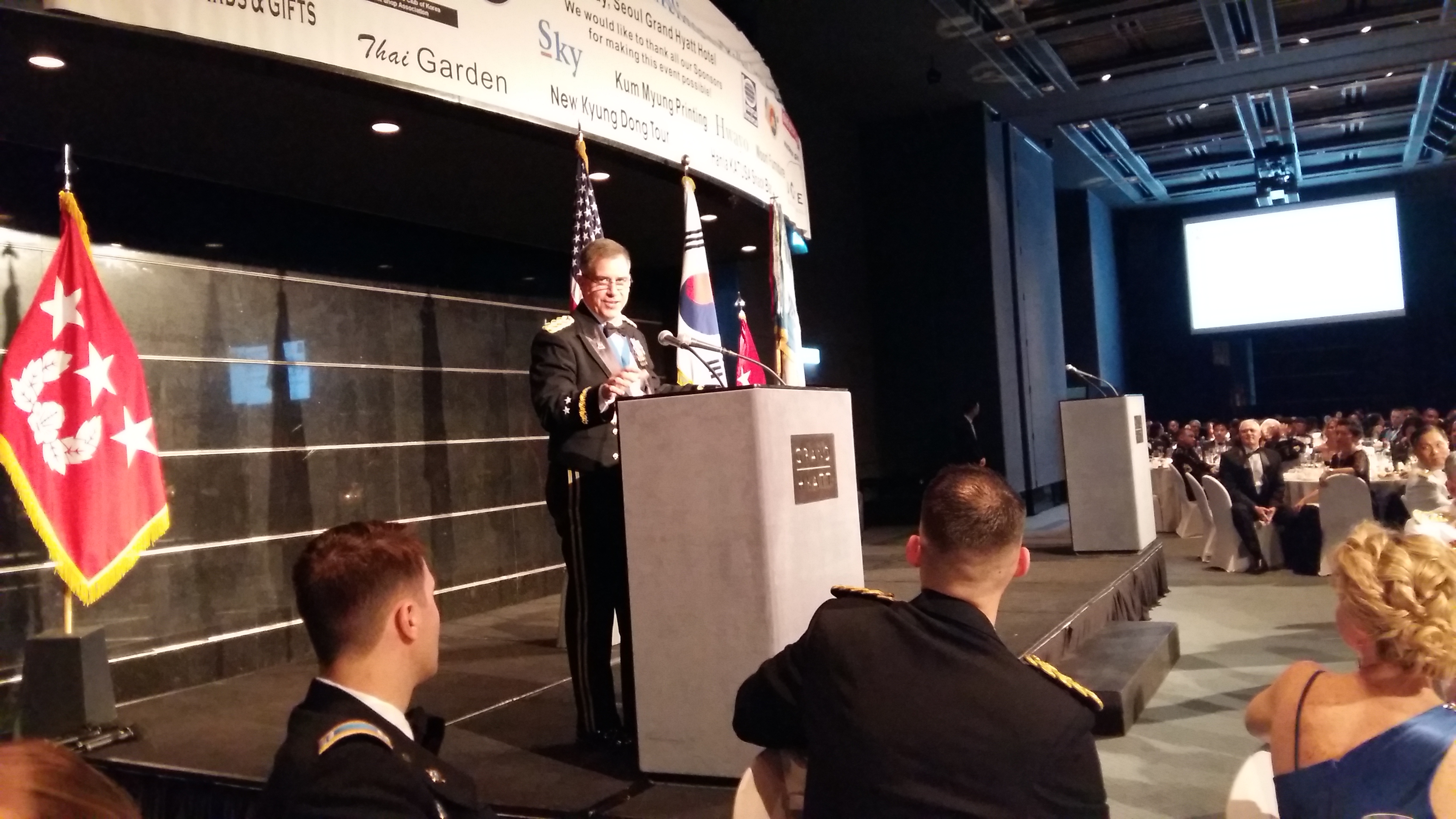
The Brigade Commander welcomed the ball guests and introduced the speakers
.
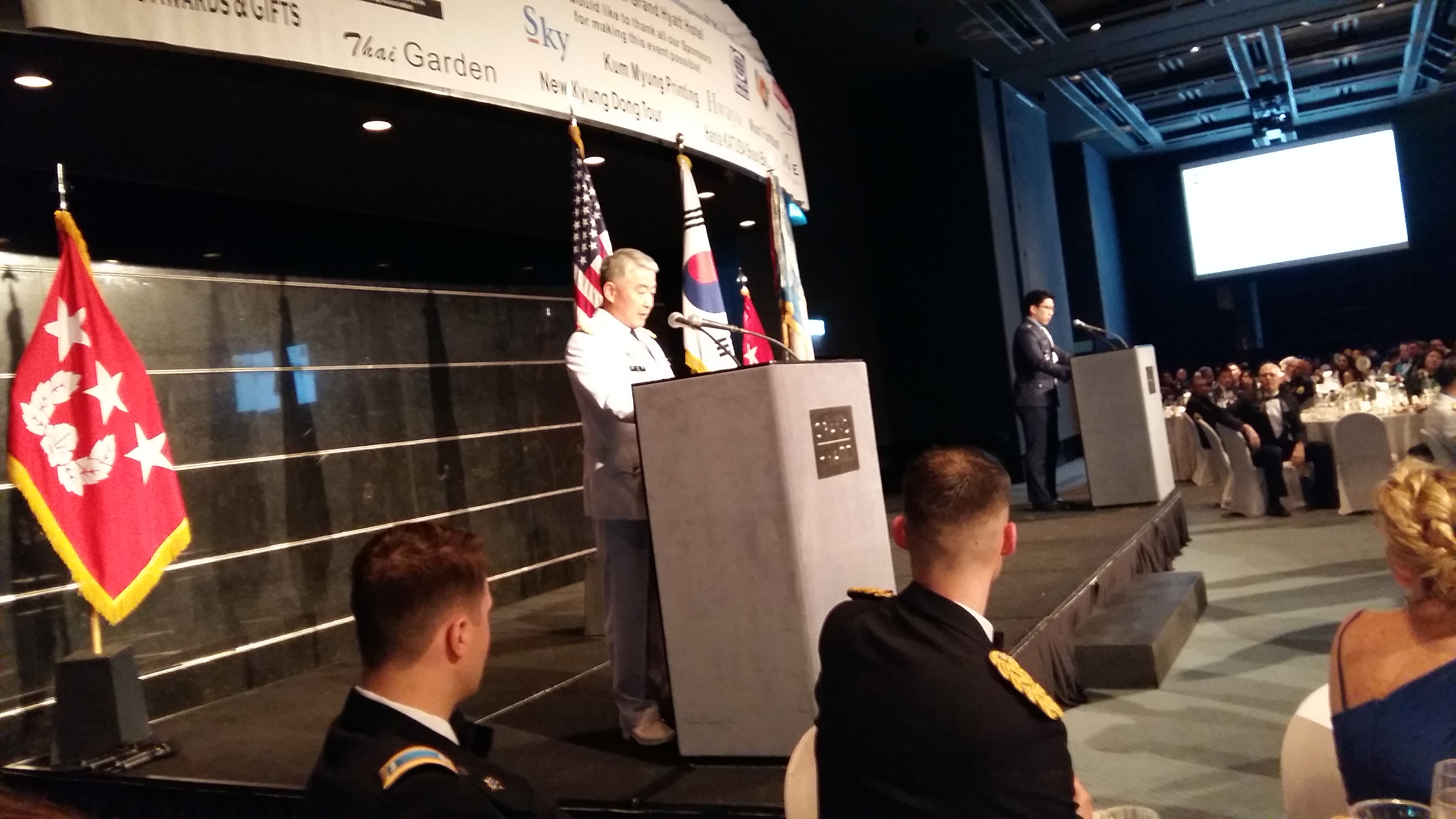
Commander of the ROK Intelligence Command addressed the crowd
.
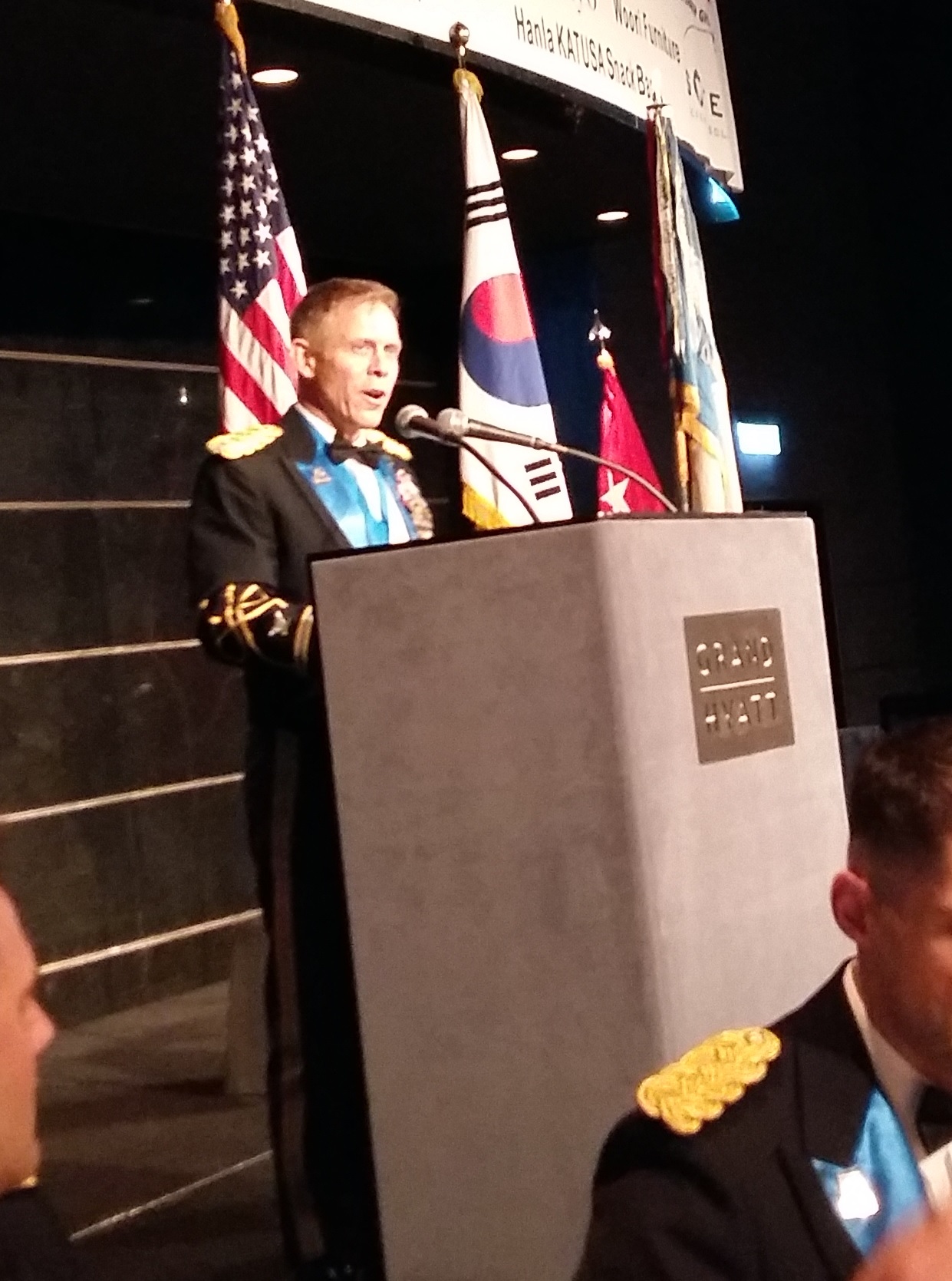
MG Christopher Ballard, the USFK J2 was the keynote speaker
.
You can’t really see them, but a baritone quartet from the Korean Military Drill Team provided entertainment.
.
The K-Pop group Switch Berry was there to entertain the youngins.
.
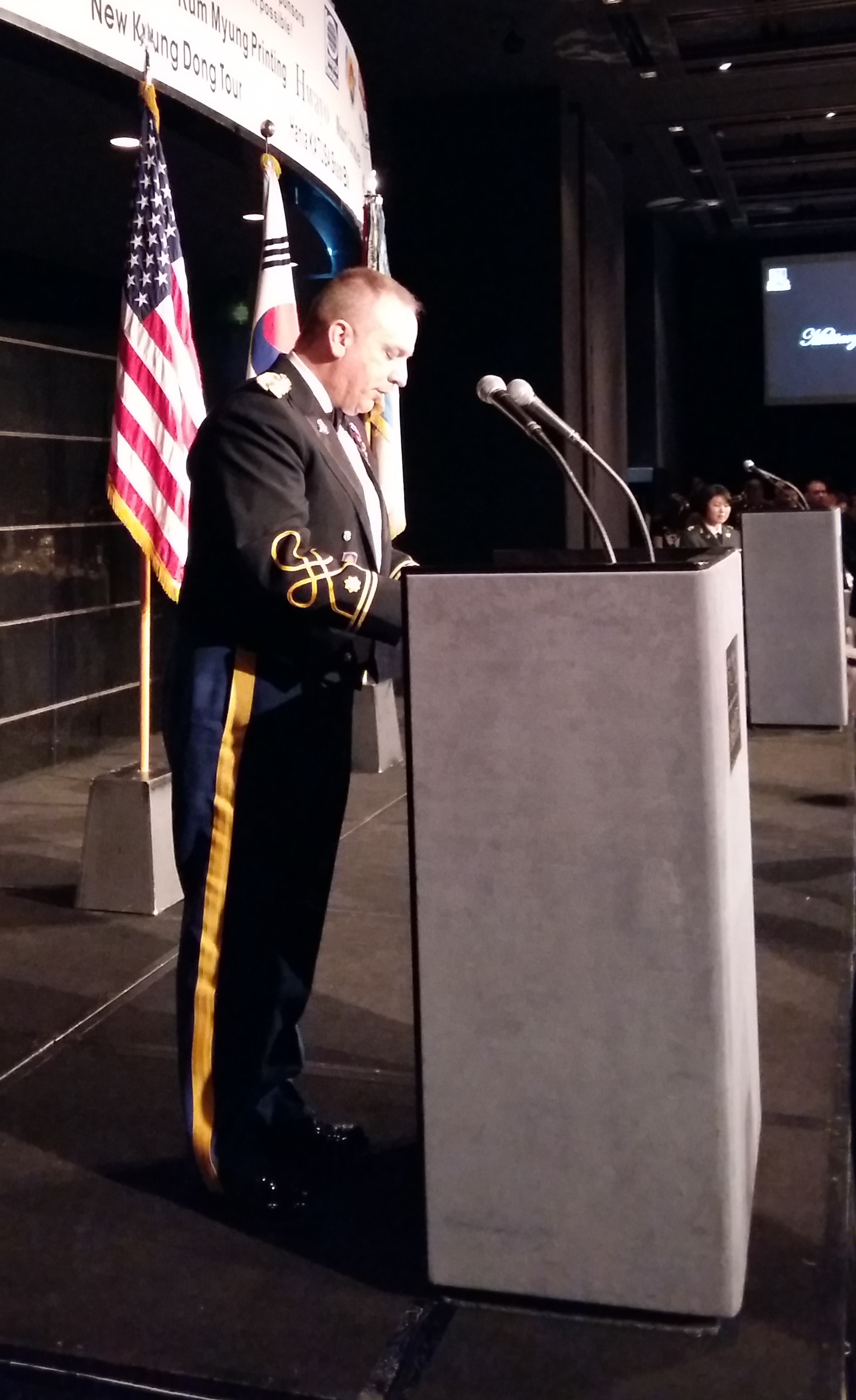
Here I am praying the closing prayer. There aren’t usually pictures of me…I guess everyone is usually praying!
.
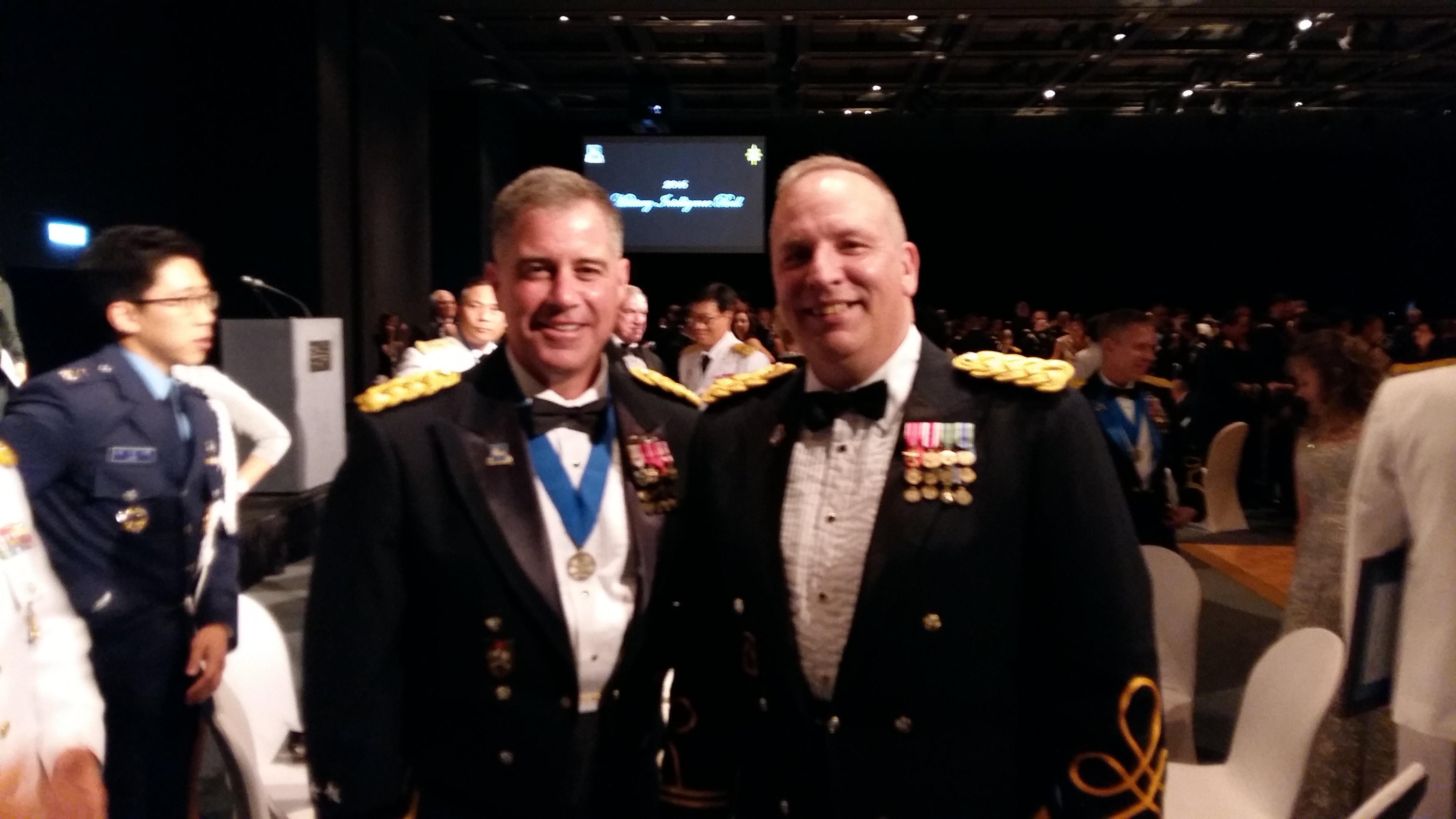
Me with MG Ballard, whose father was a chaplain
.
Me with my Brigade Commander, COL Arnold
.
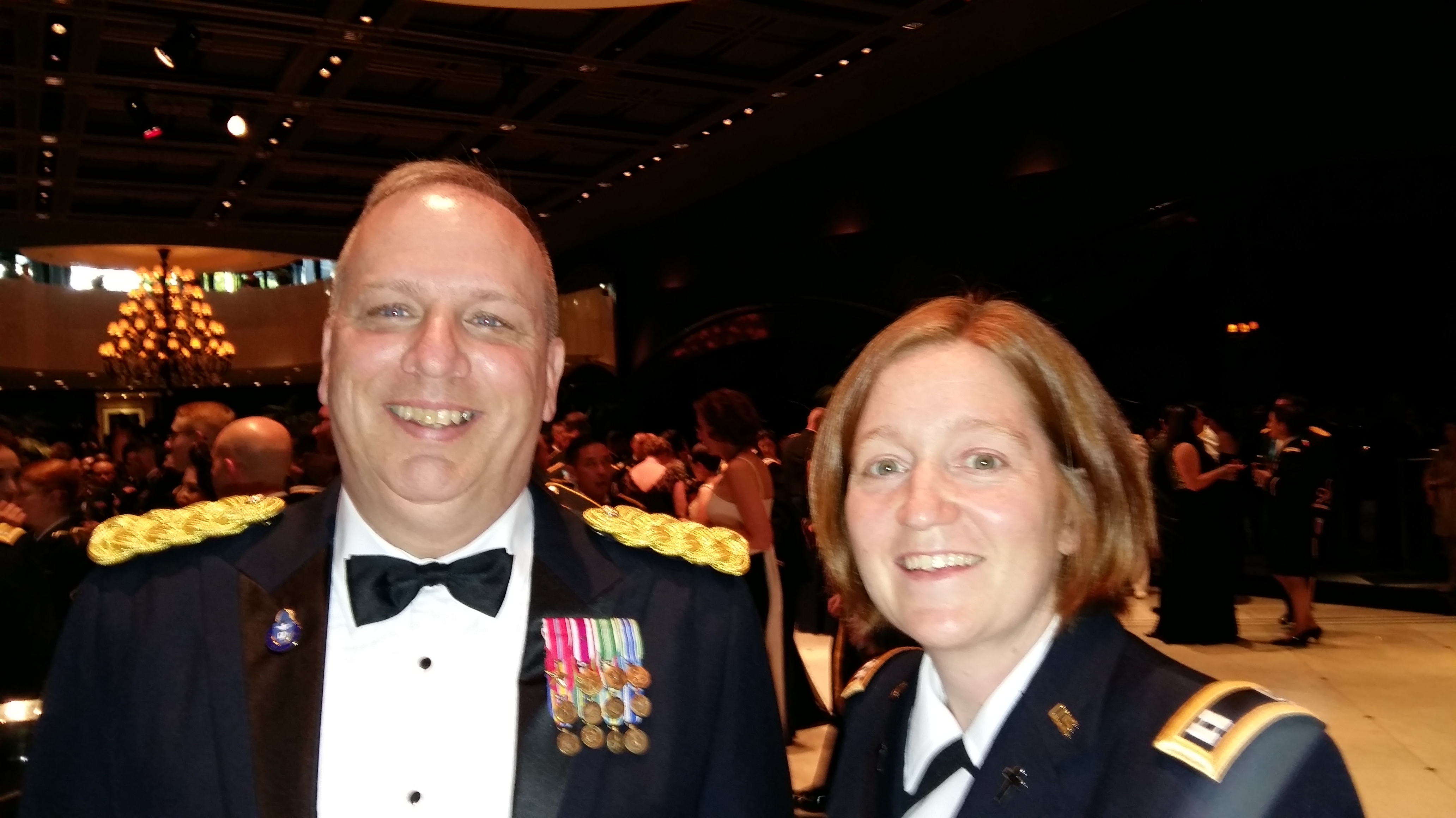
Me with one of my Battalion Chaplains, Maya Dietz
.
Me with another of my Battalion Chaplains, Brian Blake
.
Me with the two Battalion Chaplains of mine who were at the ball. The other one couldn’t be there because he attended the Aviation Ball the night before with his battalion, and he and his wife were babysitting tonight so Soldiers from his battalion could attend the MI Ball without the expense and difficulty of a babysitter.
.
Ceremony prayers aren’t that exciting since people don’t come for the prayers, but here are the two I prayed at the MI Ball tonight:
First, the Invocation:
Dear Gracious Heavenly Father,
I thank you for this day you have given us and for this occasion that we gather together to celebrate the alliance which exists between the United States and the Republic of Korea, particularly tonight- in the Intelligence community.
We realize that it is our ability to work together that preserves the armistice and protects the freedom and independence of our friends.
I thank you for all of those involved in this task before us, from the newest private to the most experienced officer, and pray for each of them that they will be protected as they perform their duties but also that they will be blessed because of the significance of our mission.
I pray now that you will be with us tonight as we celebrate the successful, continued, execution of our mission and the alliance we enjoy with each other. Bless this time with your presence and bless each one here gathered.
In your holy name I pray, Amen.
Then the Benediction or closing prayer:
Dear Father:
Thank you for this time that we’ve had together: The honors, the entertainment, the laughs, and the good food.
Thank you again for all of those here, and all the others who are serving both in uniform and as civilians, in the defense of freedom in the Republic of Korea and around the world.
Thank you also for your presence with us here this evening so far, and as we continue to celebrate. I pray that you will continue to be with us, both those here and those traveling home.
Finally, Lord, I pray that you will provide safety tonight and in the days ahead. And I pray that you will especially bless the Republic of Korea and the United States of America as we live and serve together.
Hail and Farewell gatherings are a long-standing tradition in the military to welcome Soldiers just coming into the unit and say “farewell” to those who are leaving. The Army doesn’t have a prescribed ceremony or format for Hail and Farewells, it is up to each unit to decide how often to have them and what they will be composed of.
The brigade I am leaving tried to have them every other month or so, so there was never too many being hailed or farewelled. Coming up on PCS season, however, there are a lot more changes, so they started farewelling people farther away from their actual departure than normally would be done. I was farewelled a full three months before I was scheduled to leave!
This Hail and Farewell was held at a massive buffet that had a variety of Korean, Chinese, Western and all sorts of types of food to include breads, fruits and desserts. There was too much to chose from, but it all looked good. Of course, one of the criteria for picking the location is that they have a meeting room so that we can be separated from the rest of the restaurant guests.
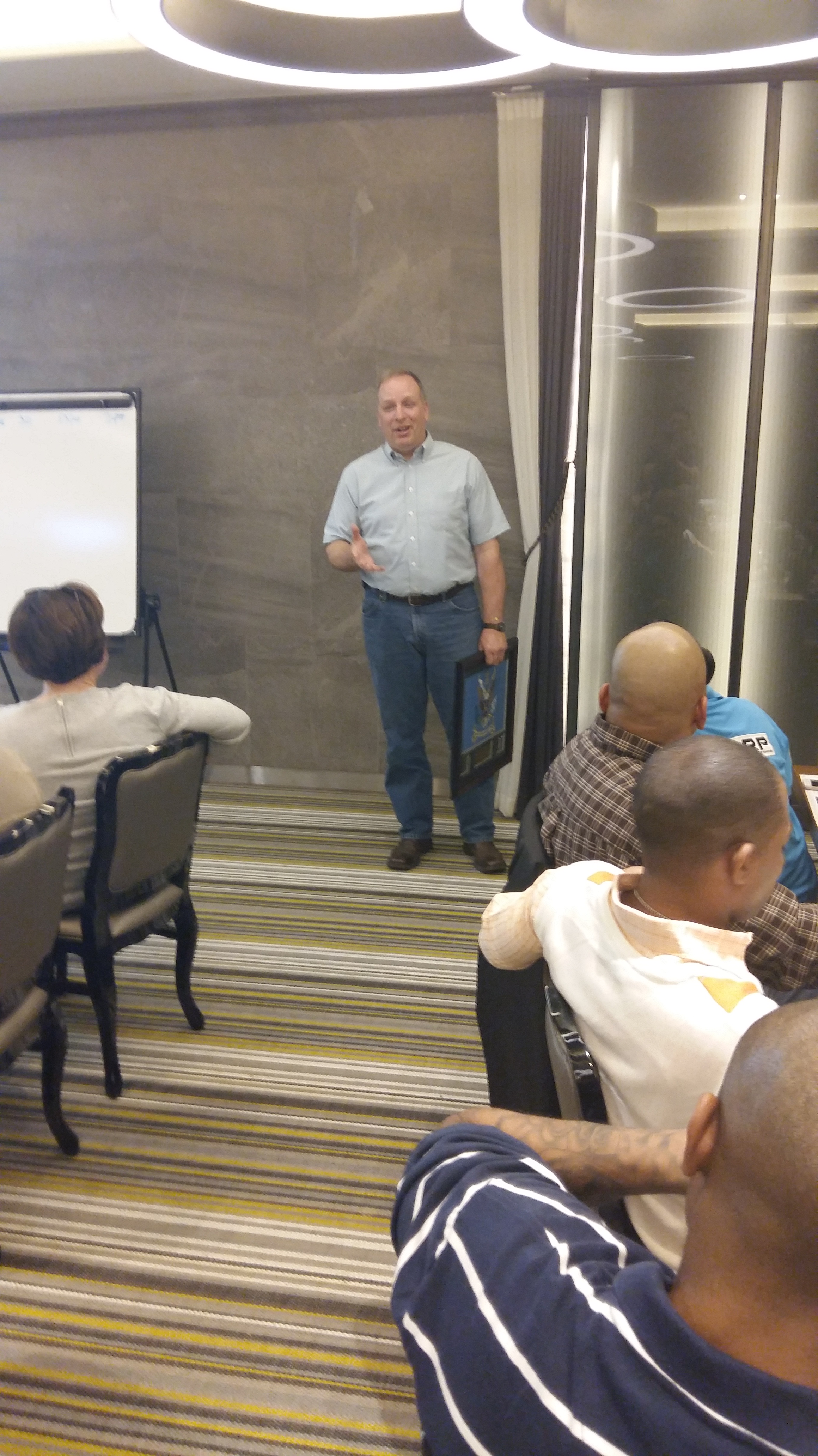
The new Command Sergeant Major was being hailed the night I was being farewelled. When being hailed, the commander or your supervisor shares a little background about you: past assignments, family, hobbies, etc.When you’re being farewelled, your supervisor, or in my case the Brigade Commander, talks about your contribution to the unit mission.Usually you’re presented a farewell gift, often the “colors” of the unit. Sometimes it’s another symbol of the unit or location. Some received a Korean Familial Bell.A close-up of the colors I received.I also received a Brigade Commander’s coin.The farewellee is given a chance to speak, often thanking those who contributed to their success.Many times there are games or some other form of entertainment.Continuing to play a gameOf course, there’s food, too. I can’t say that I ate any of this fish…I didn’t eat any of this fruit, either.I did have Bulgogi Pizza
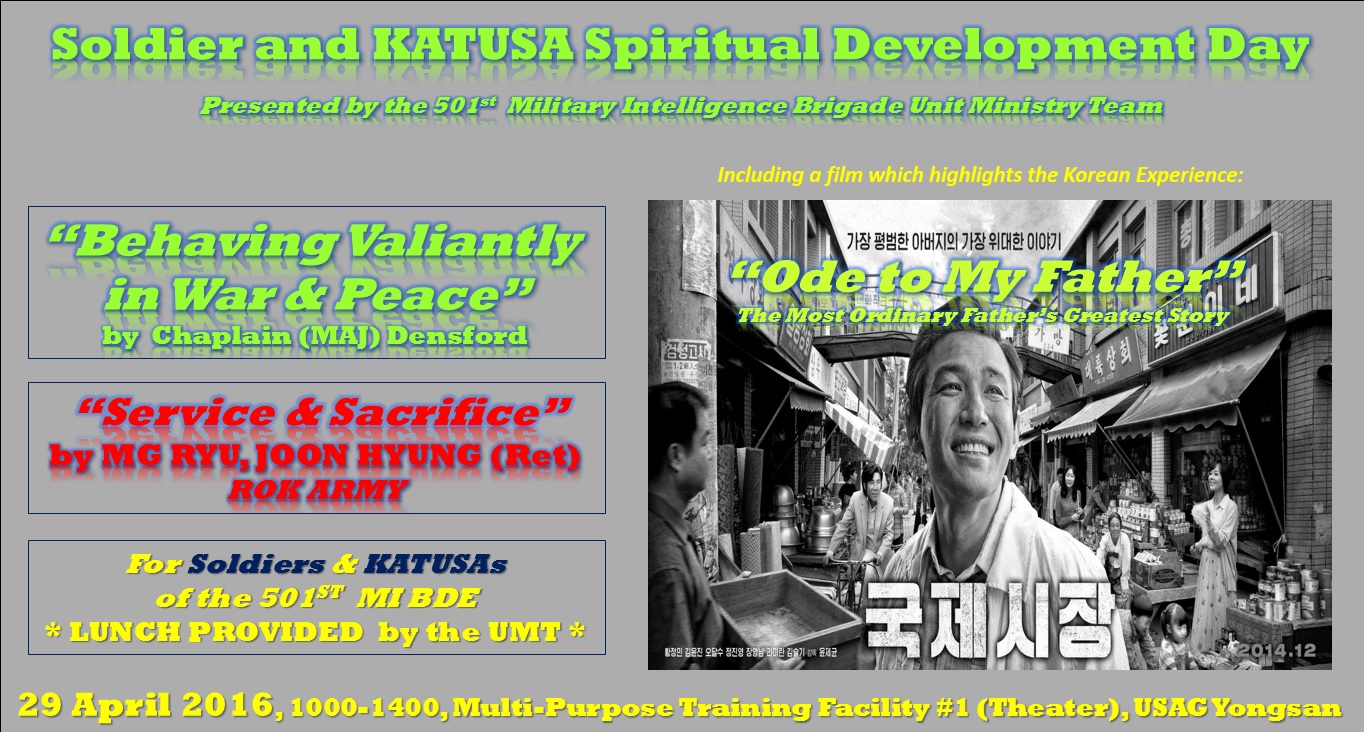
Occasionally Unit Ministry Teams offer events to help Soldiers develop personally, professionally and spiritually. Our brigade UMT offered one such event today. We named it, “Soldier and KATUSA Spiritual Development Day.” Our plan was to have U.S. and Korean veterans from the Korean War to speak to our Soldiers, and I would provide a presentation on “Behaving Valiantly in War and Peace.” We would round out the day with a movie that explains the Korean experience, “Ode to My Father,” with lunch provided, of course.
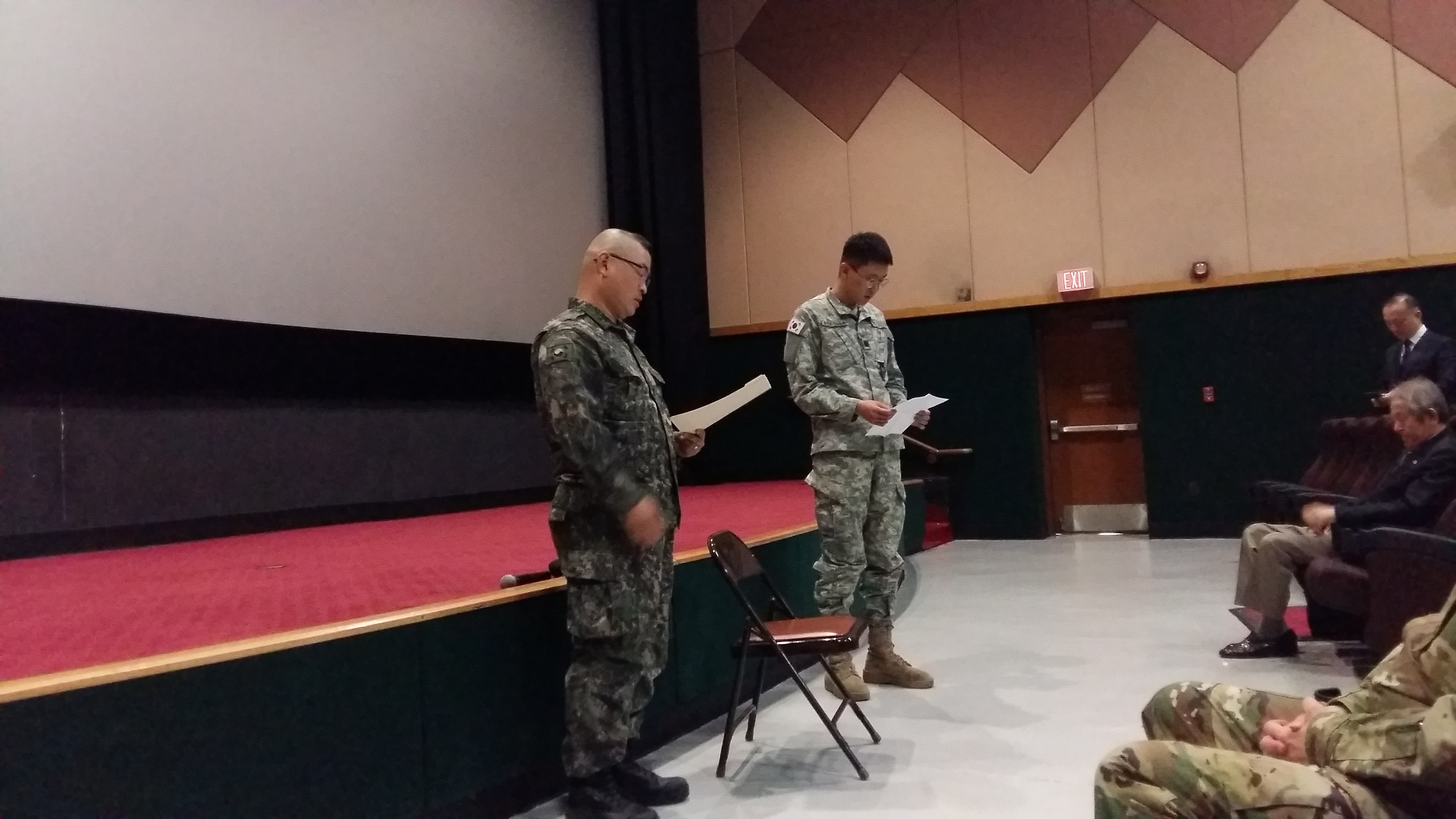
MAJ Kim, the ROK Army officer in charge of our KATUSAs, introduced our guest speaker, MG Joon Hyung Ryu, with these comments (edited only for better translation):
The guest today is MG (Retired) Ryu, Joon Hyung who participated in both the Korean and Vietnam Wars and served as the Deputy Commander of ROK-US Field Command.
The Korean War refers to the 3 year war which started when North Korea invaded ROK at 0400 on June 25th with the support of the Soviet Union and lasted 1,129 days until both sides agreed to a truce at 1000 on July 27, 1953.
It was a tragic and fierce war that almost two million Soldiers among 26 nations took part in on this small peninsula. There were 620,000 ROKA, 160,ooo U.N., 930,000 North Korean, 1,000,000 Chinese, and 2,500,000 civilian casualties and also resulted in 10,000,000 separated family members, more than half of the 30,000,000 North and South Koreans.
Even now, the Korean Peninsula suffers from division after over 60 years.
MG Ryu was commissioned as a 1LT in November 1950 and is a war hero who stood up and defended Hill #854 on the eastern front line in Injaegoon, Gangwon Province from the final attack of the Chinese and North Korean armies. This battle is called the Battle of Ssangyong Highland.
MG Ryu was the first Korean to graduate from the U.S. Army Infantry Airborne School in 1957 and on 1 April 1958, he became the main founding member of the 1st Airborne Brigade which is now the Special Operations Command.
After that, he was deployed to the Vietnam War and distinguished himself serving on the command staff of various main units.
In 1980 he worked as the Commanding General of the 8th Infantry Division then in 1982, became the Deputy Commander of the ROK-US Field Command. In 1985 he retired as a Major General.
After retirement, he actively worked as the Chairman of the Korean Parachute Association and Defense Industry Association. Now he is the Chairman of the Patriot Lee Dong Hwi Memorial Organization who was head of the Military Ministry and the first Prime Minister.
I introduce to you ROK war hero, MG Ryu.
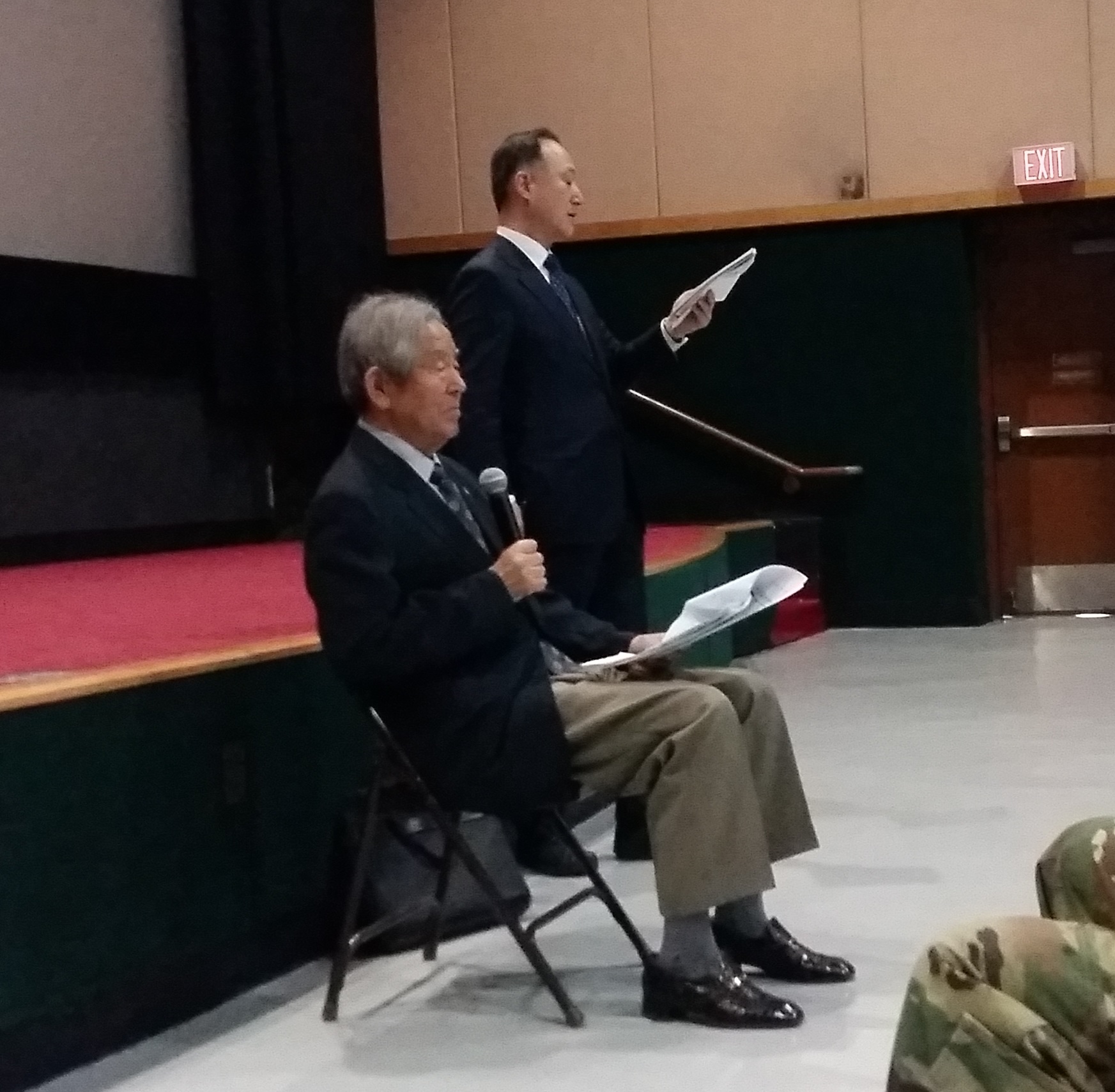
MG Ryu (seated) with the interpreter
MG Ryu presented a history of Korea-International relations, highlighting relations with the United States and the significance and necessity of the Korean-U.S alliance. It was great to hear about history from one who was part of that history.
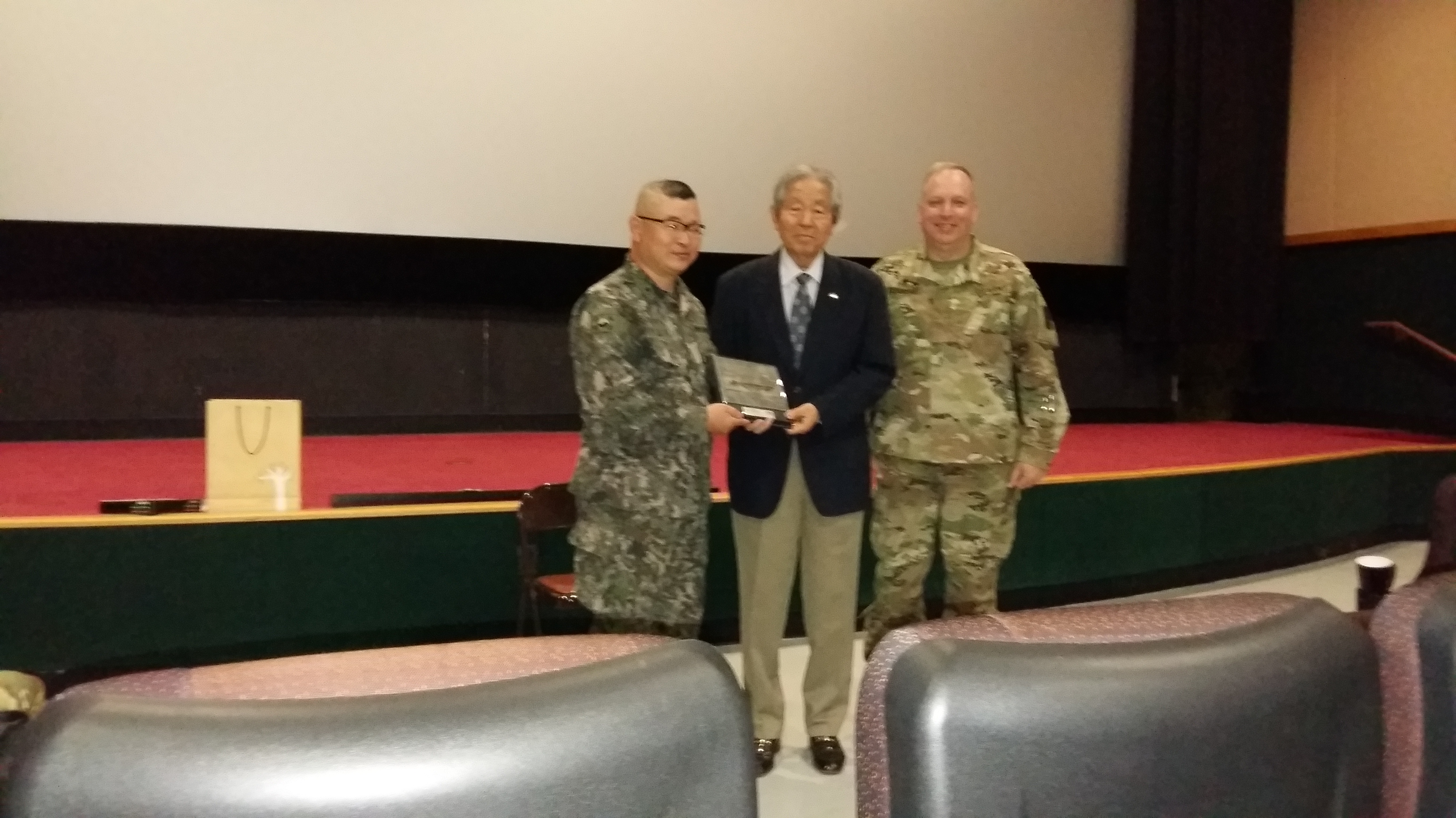
Me presenting a gift to MG Ryu for spending time with usMAJ Kim (left) and me (right) with MG Ryu (center) after MAJ Kim gave gifts to MG Ryu to thank him for being with us
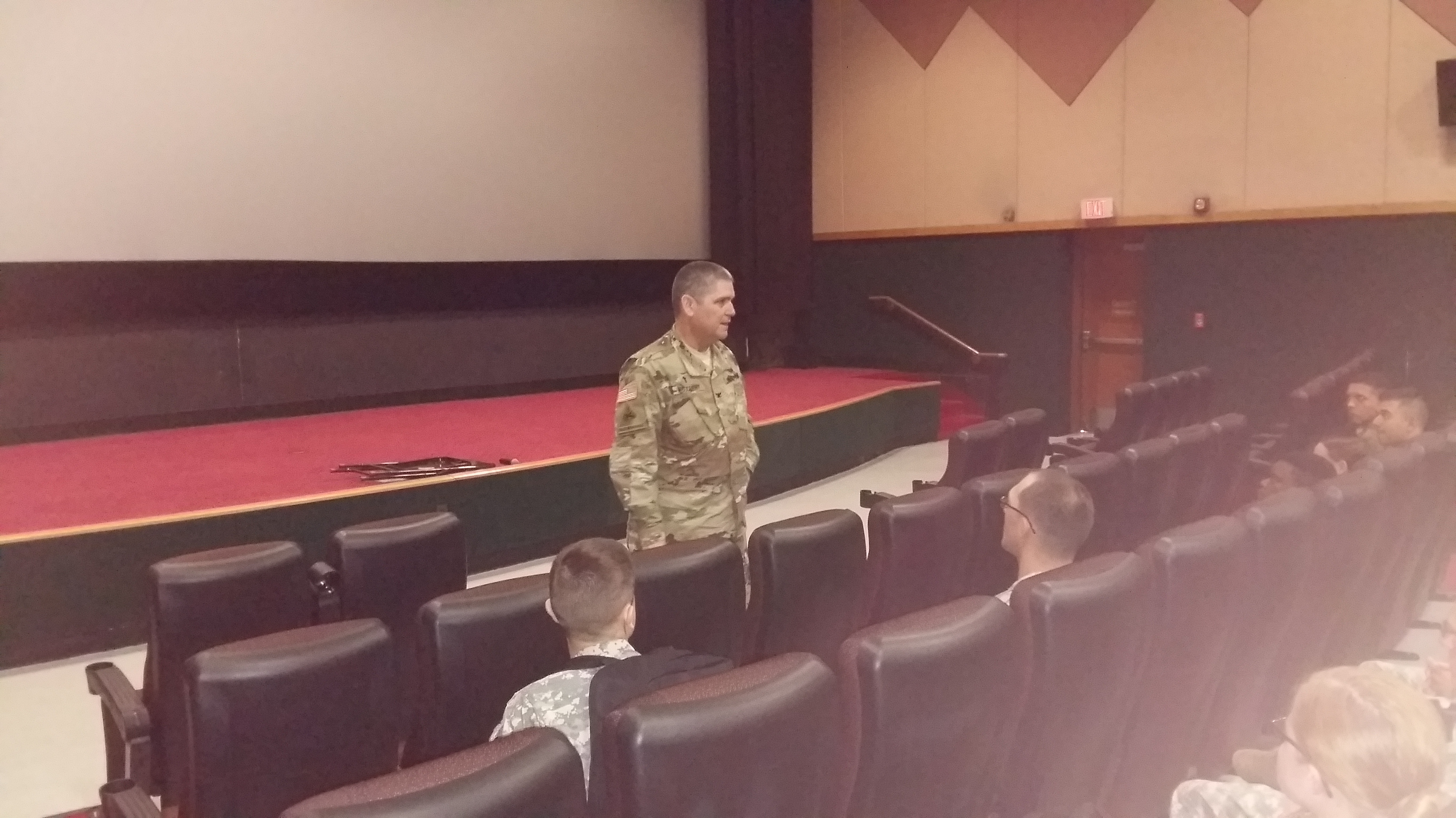
Coincidentally, the INSCOM Chaplain was visiting Korea so was in attendance and added to MG Ryu’s presentation, tying in the importance of what we, as U.S. Soldiers, do here in Korea and how even we are in the midst of making history as we preserve the peace and defend freedom on the Korean Peninsula.
The INSCOM Chaplain speaking to our groupThe INSCOM Chaplain (left) talking to MG Ryu about his experiences
Next, MAJ Kim also introduced the film, “Ode to My Father” with these comments:
The film you are going to see today is a Korean movie named “Ode to My Father,” or literally translated from the Korean, “International Marketplace.” It is a film about Korean fathers after the Korean War of the 1950s.
After the war, many people lost everything and some families were separated forever.
This movie depicts the heartbreaking story about fathers who had to travel to West Germany coal mine and sacrifice their lives in the Vietnam War just to rebuild the nation of Korea and protect their families.
My own mother was an only daughter of an affluent family in North Korea and was a refugee who fled from the Chinese Army’s invasion of ROK in a U.S. transportation ship. She is one of 10 million separated families due to the war.
The story of the movie is more than a random family’s history, it is a people’s history of overcoming [adversity] that all of ROK citizens had to suffer.
I hope this film will be a better opportunity to understand Korea and the Korean people.
MAJ Kim, ROKA (left), introducing MG Ryu with MAJ Kim’s KATUSA/Interpreter (right).
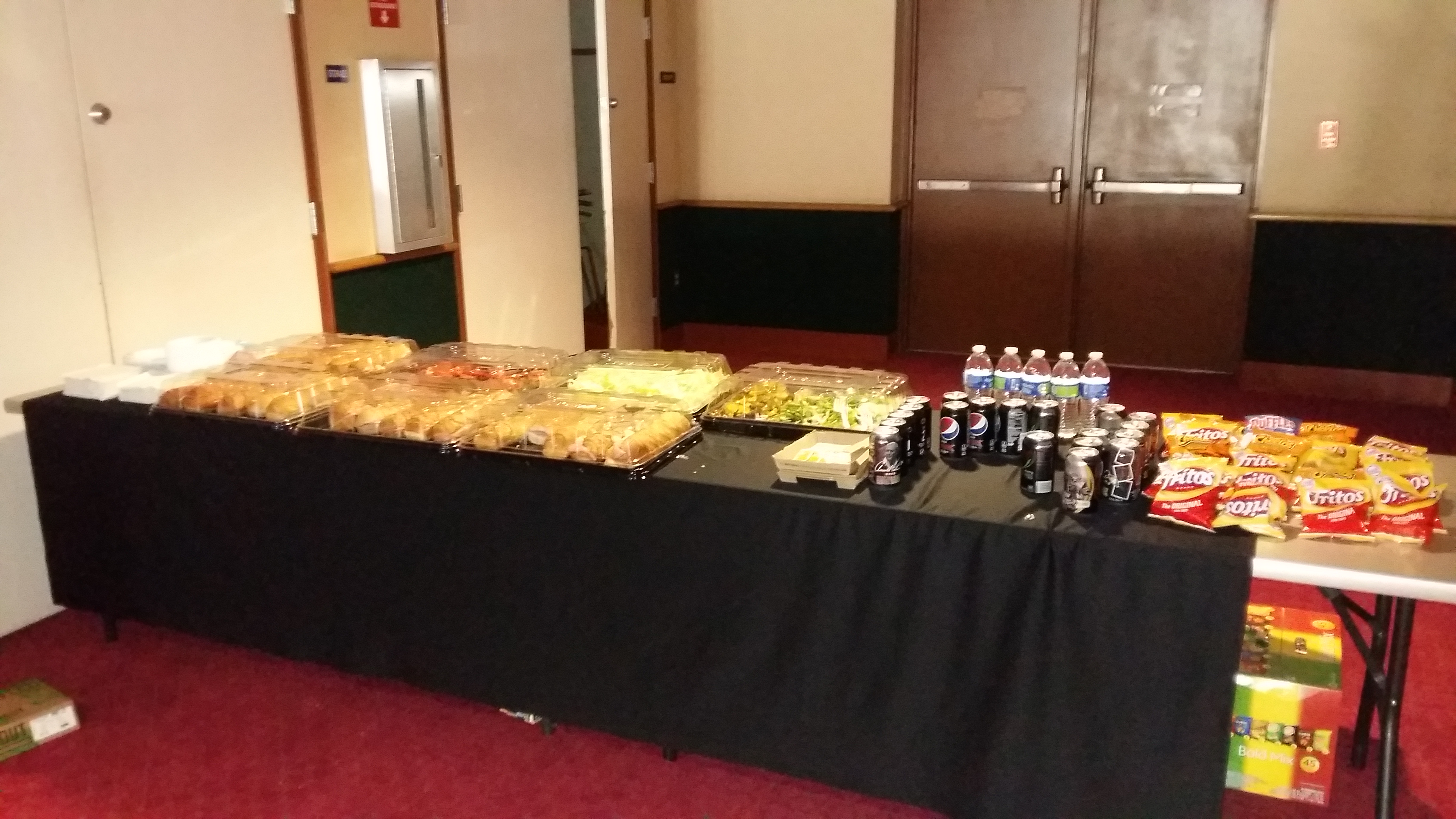
We provided lunch from Subway (which is always a treat) and showed the film which is the story of a family who was separated during the evacuation of North Korea as China was invading from the North.
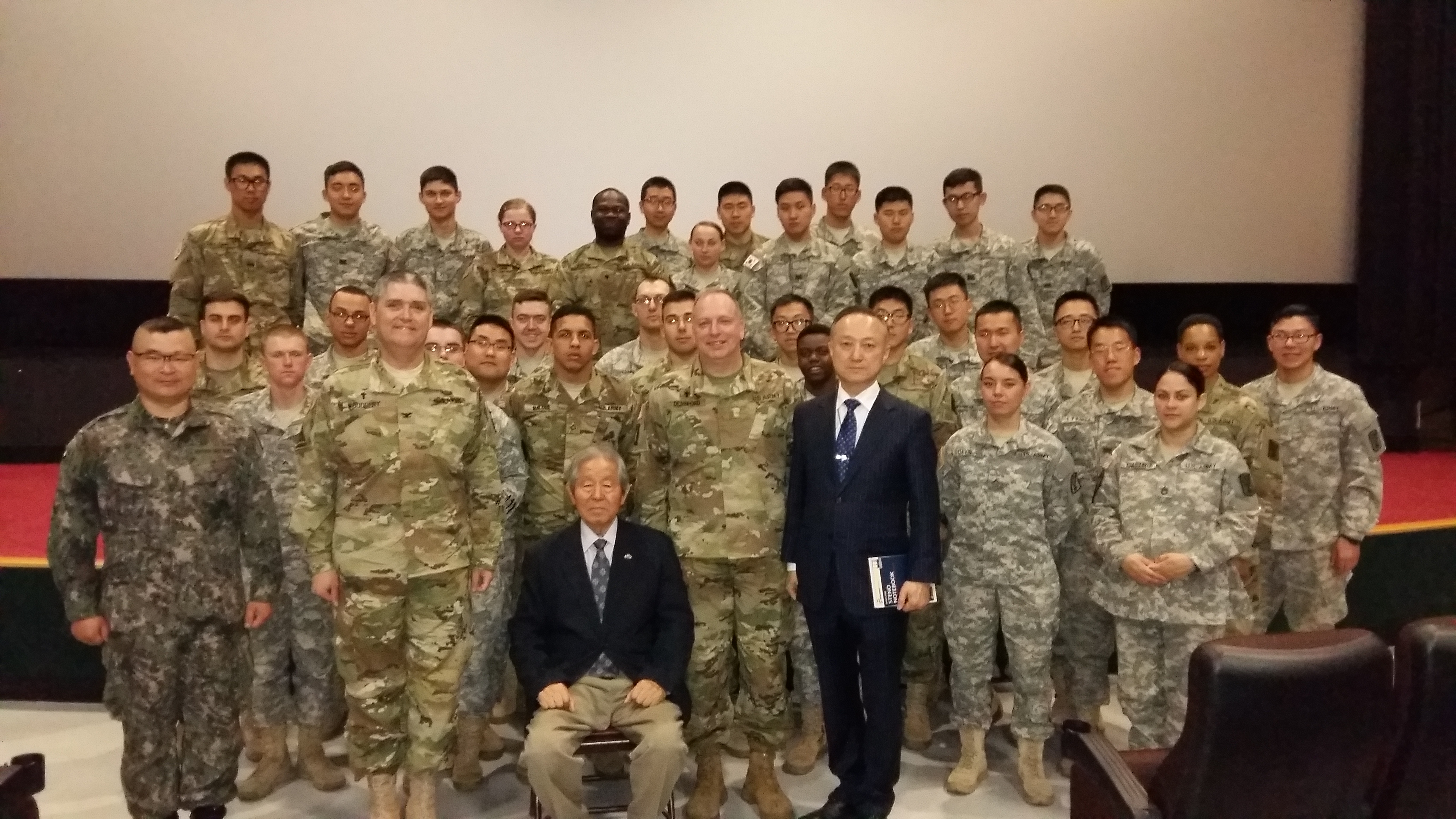
A group of Soldiers and KATUSAs from the BDE with MG Ryu (seated), the INSCOM Chaplain (left of MG Ryu), MAJ Kim (far left) and me (right of MG Ryu). The interpreter is in a suit to my left.
Since the Armistice Agreement was signed on 27 July 1953, the Demilitarized Zone (DMZ) running for 160 miles roughly along the 38th parallel from the East Sea to the Yellow Sea, has been one of the most unusual places on earth. Less than 35 miles from Seoul, the capital of the Republic of Korea (South Korea), the 2 1/2 mile wide DMZ is centered on the Military Demarcation Line (MDL), the political border, the violation of which could get you shot.
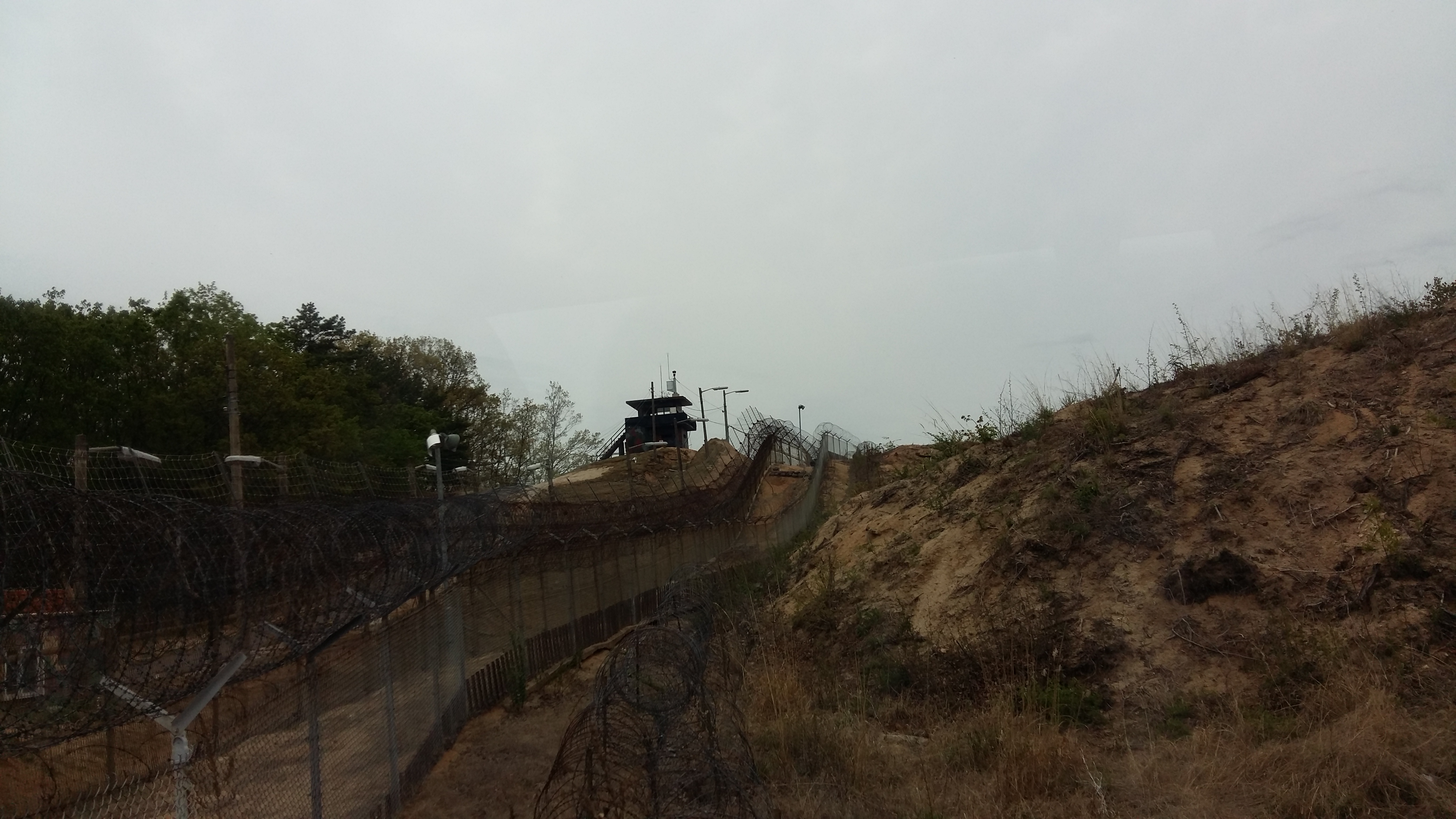
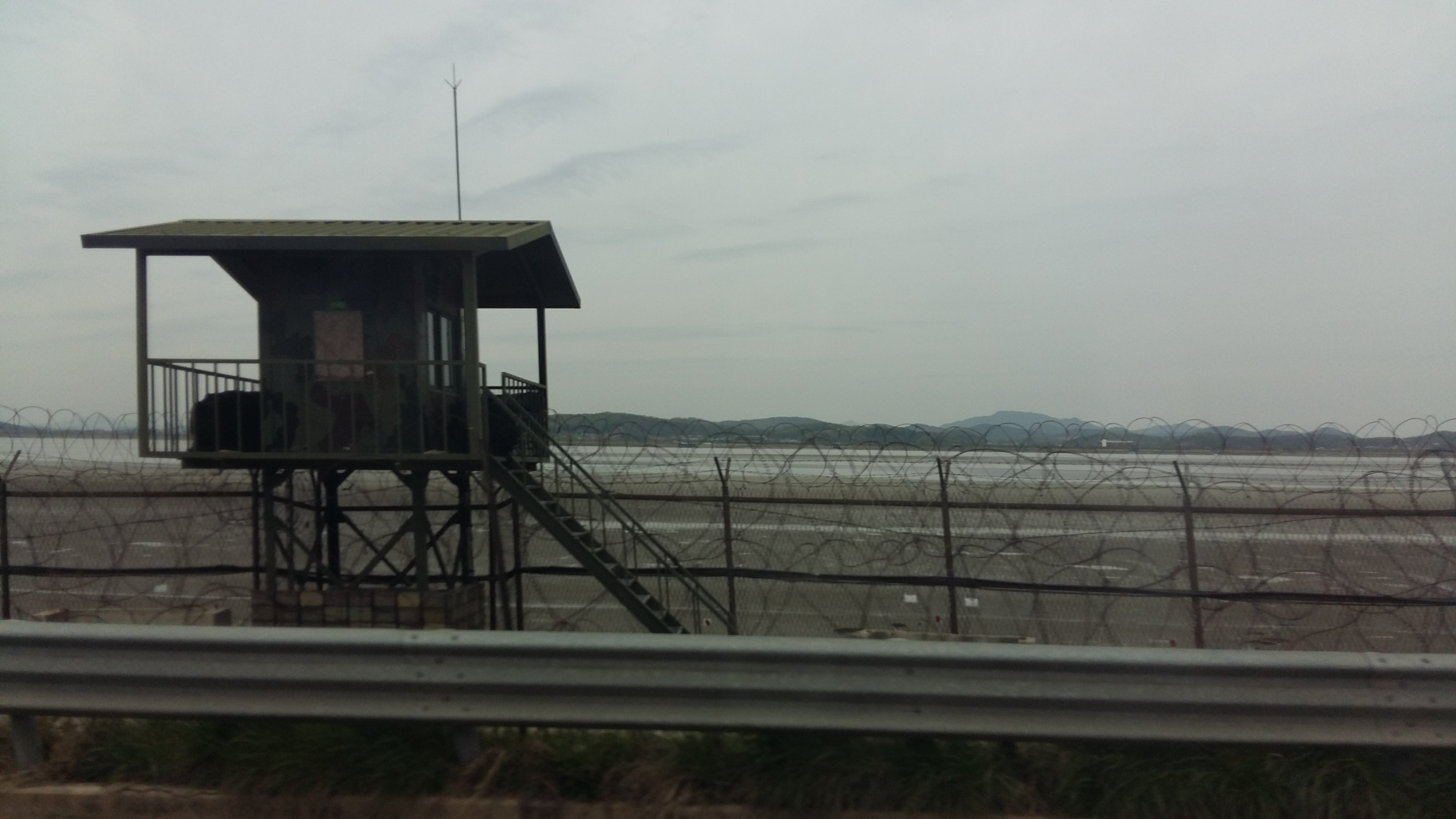
There are guard towers all along sections of the DMZ.
Despite the name which seems to indicate a lesser degree of militarization, the DMZ is extremely militarized with the North and South facing off eyeball to eyeball as though the war which preceded the armistice is just paused. The agreement, however, prevents either side from introducing large weapons or large numbers of troops within the DMZ, which acts as a buffer zone between the two belligerent nations, who, ironically, do not recognize each other as legitimate governments.
My visit to the DMZ was to the area known as the Joint Security Area which originally was jointly governed by North and South Korea, but after soldiers from North Korea killed 2 American officers and 4 South Korean Soldiers with axes the U.N. Soldiers were using to remove limbs from a tree which was blocking visibility between guard posts in August 1976, the MDL was established, separating the two and leaving the only area of responsibility that overlap being Panmunjeom. Panmunjeom is an 800 meter area which is most famously home to the building where the armistice was signed.
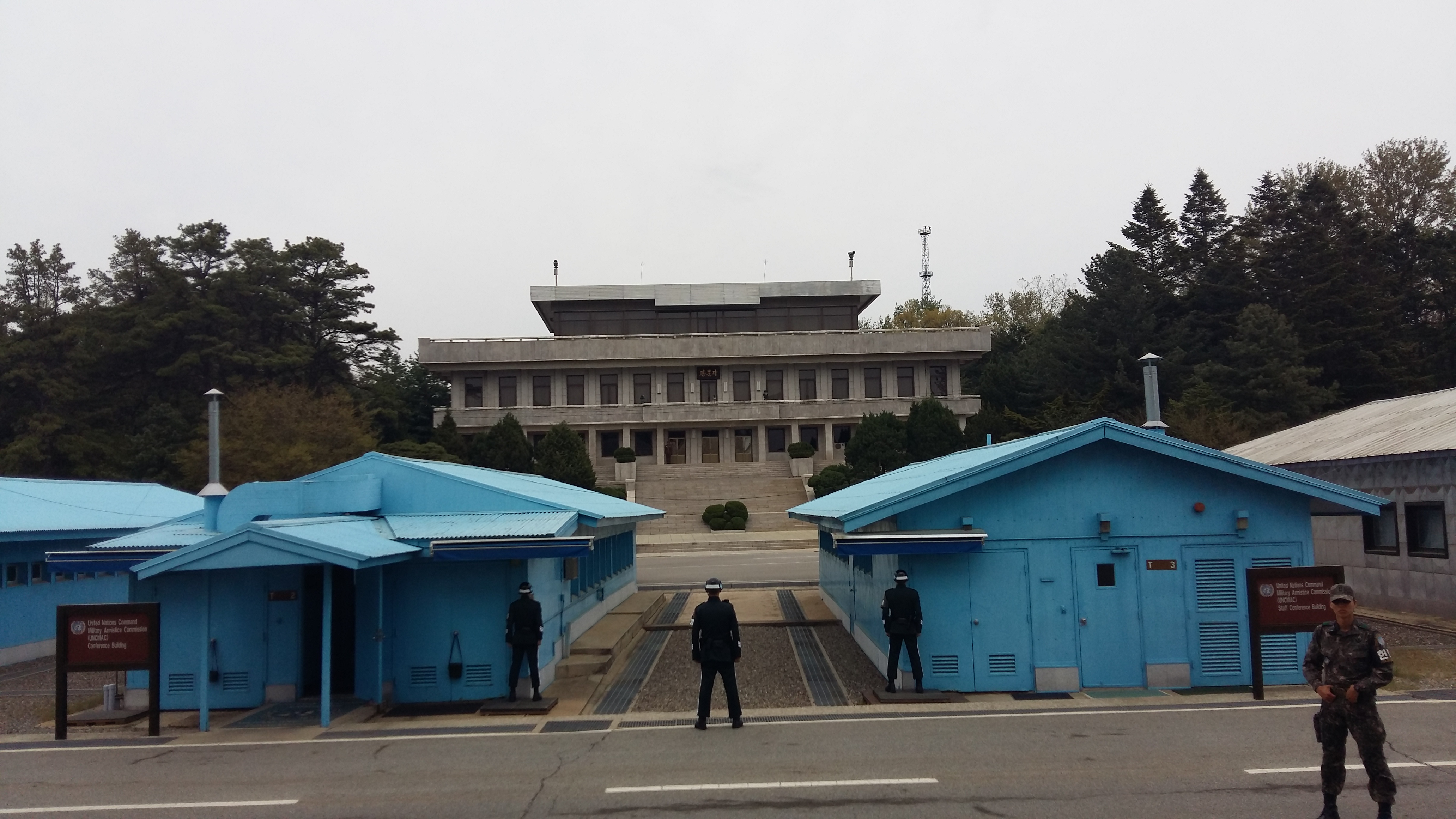
Panmunjeom. The blue building on the left is where the Armistice Agreement was signed in July 1953. The large building in the back is Panmungak, in North Korea, used as a waiting are for North Korean visitors and guards. If you look closely, you can see a North Korean Soldier just left of center of Panmungak.Inside the Panmunjeom conference building. The center table sits on the line between North and South Korea and is where the military leaders signed the Armistice Agreement ending hostilities during the Korean War.
The battalion tasked with security of the area around the JSA, formally known as the United Nations Command Security Battalion, operates under the Armistice Agreement, reporting directly to United Nations Command. the UNCSB is one of the few purely joint-nation battalions composed of approximately 10% U.S. Soldiers and 90% ROK Soldiers. Together, they are responsible for monitoring the area around the JSA, protecting visitors to the area and those who work in the zone, and executing the education mission (which includes tours of the significant sites around the DMZ).
.
North Korea has always been antaginistic toward the South and countries allied to them. For years, plans have been in the works to re-invade the South. In 1978, as a result of information received from a North Korean defector, a third infiltration tunnel was discovered. This tunnel is about a mile long and about 6 1/2 feet in diameter. Had this tunnel been used by the North for an invasion, 30,000 soldiers per hour could have traveled through it. It is said that there still could be 20 tunnels running under the DMZ which are yet to be discovered.
The entrance to Tunnel #3. There are no photographs permitted within the tunnel.
.
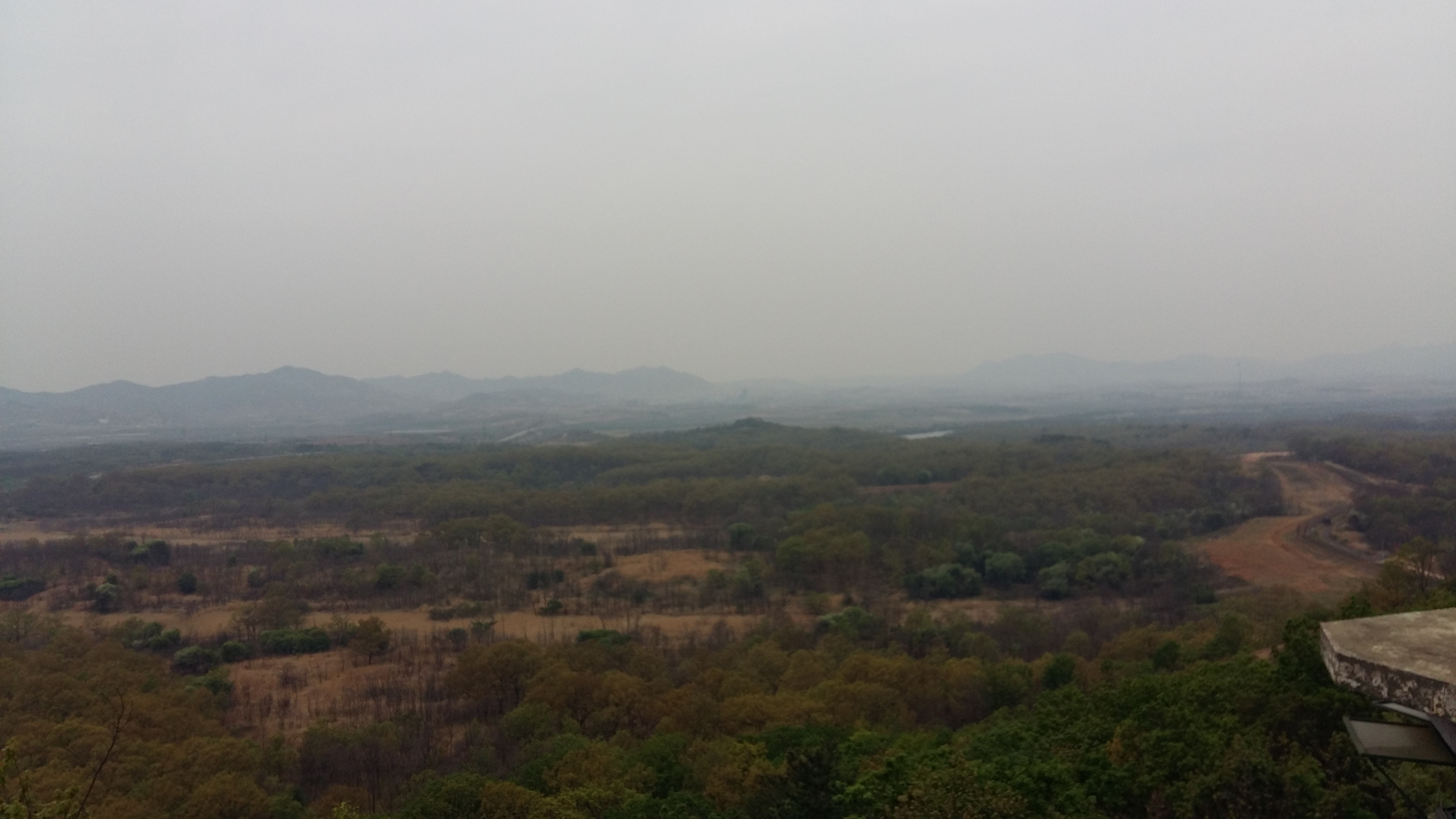
Near the DMZ in Peju on Mt. Dora is the Dora Observatory where onlookers can view several sites in North Korea. There are tourist binaculars available, but to take a photograph toward the North, you have to stand behind a line well behind those binaculars. Without recording what you see, you get a great view of North Korea from this observatory, though I did take a few pictures before I was told we couldn’t.
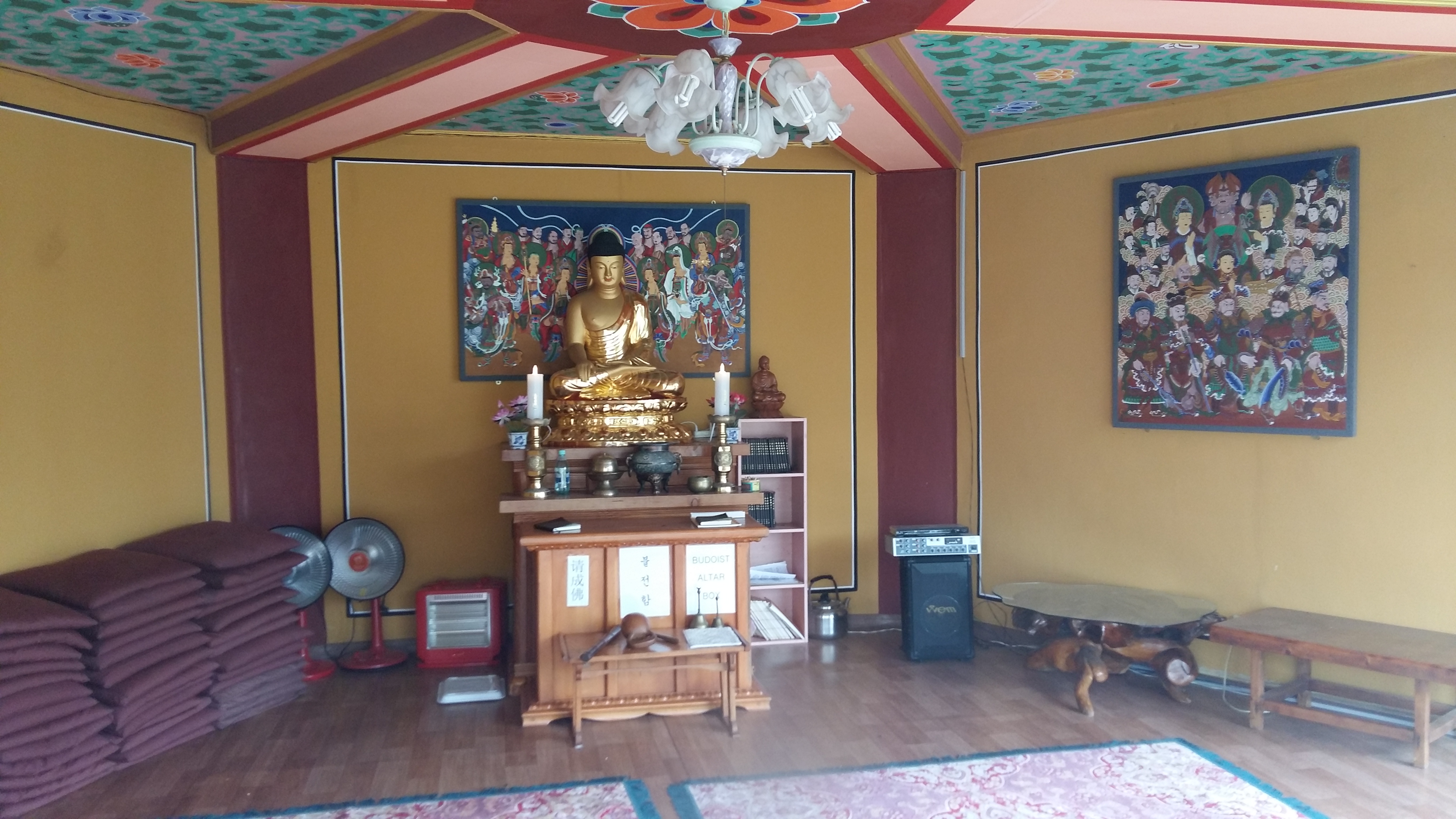
Dora Observatory in PejuA view of North Korea from the Dora ObservatoryThere is a small Buddhist shrine next to the Dora Observatory. On top is a traditional Buddhist bellInside the Buddhist shrine next to Dora Observatory.
.
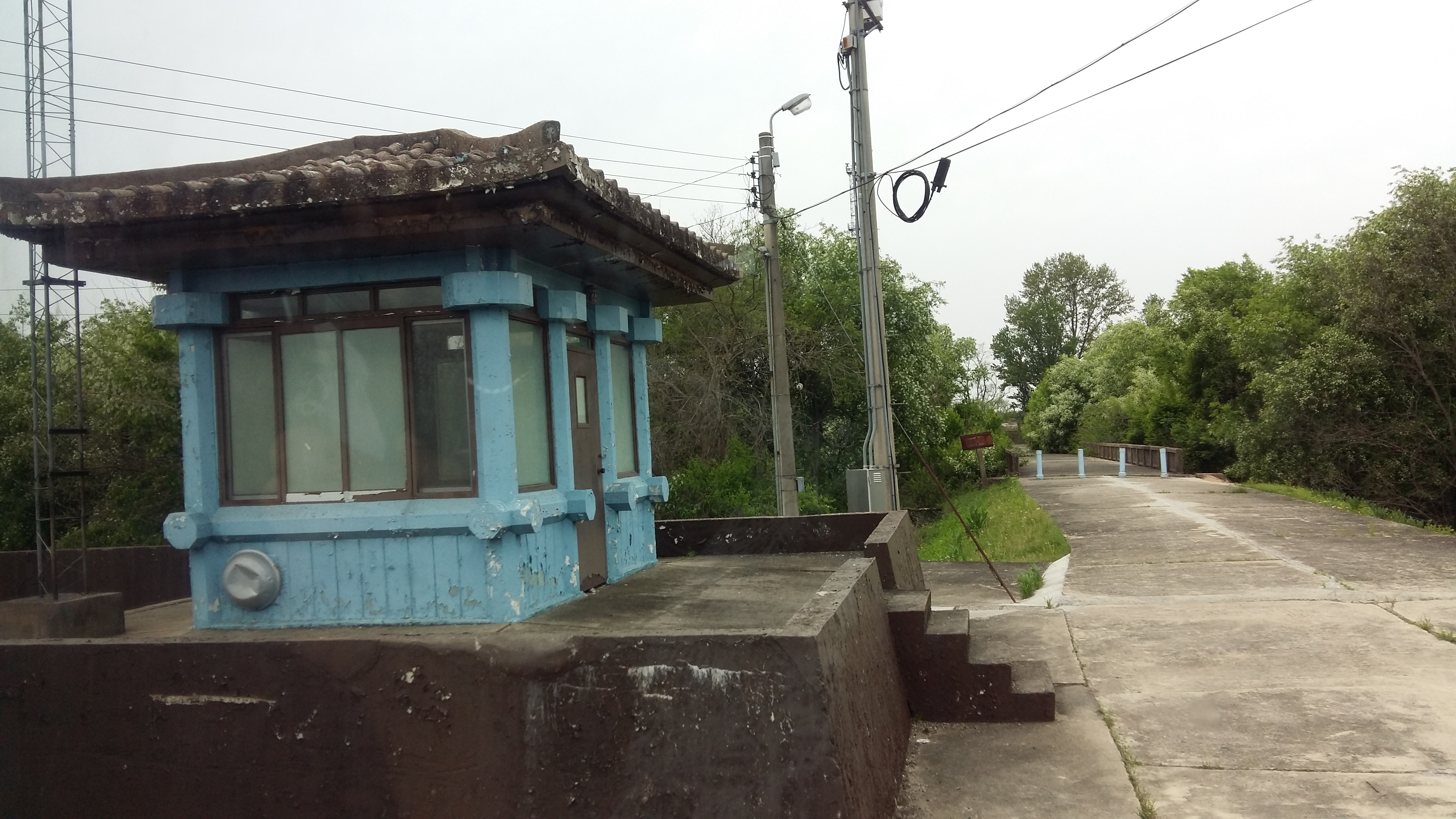
In 1953, following the signing of the Armistice Agreement, prisoners of war (POW) were exchanged over what became know as the “Bridge of No Return,” so named because once a POW returned to the North, they would not be permitted to come back to the South.
Bridge of No Return within the DMZ
.
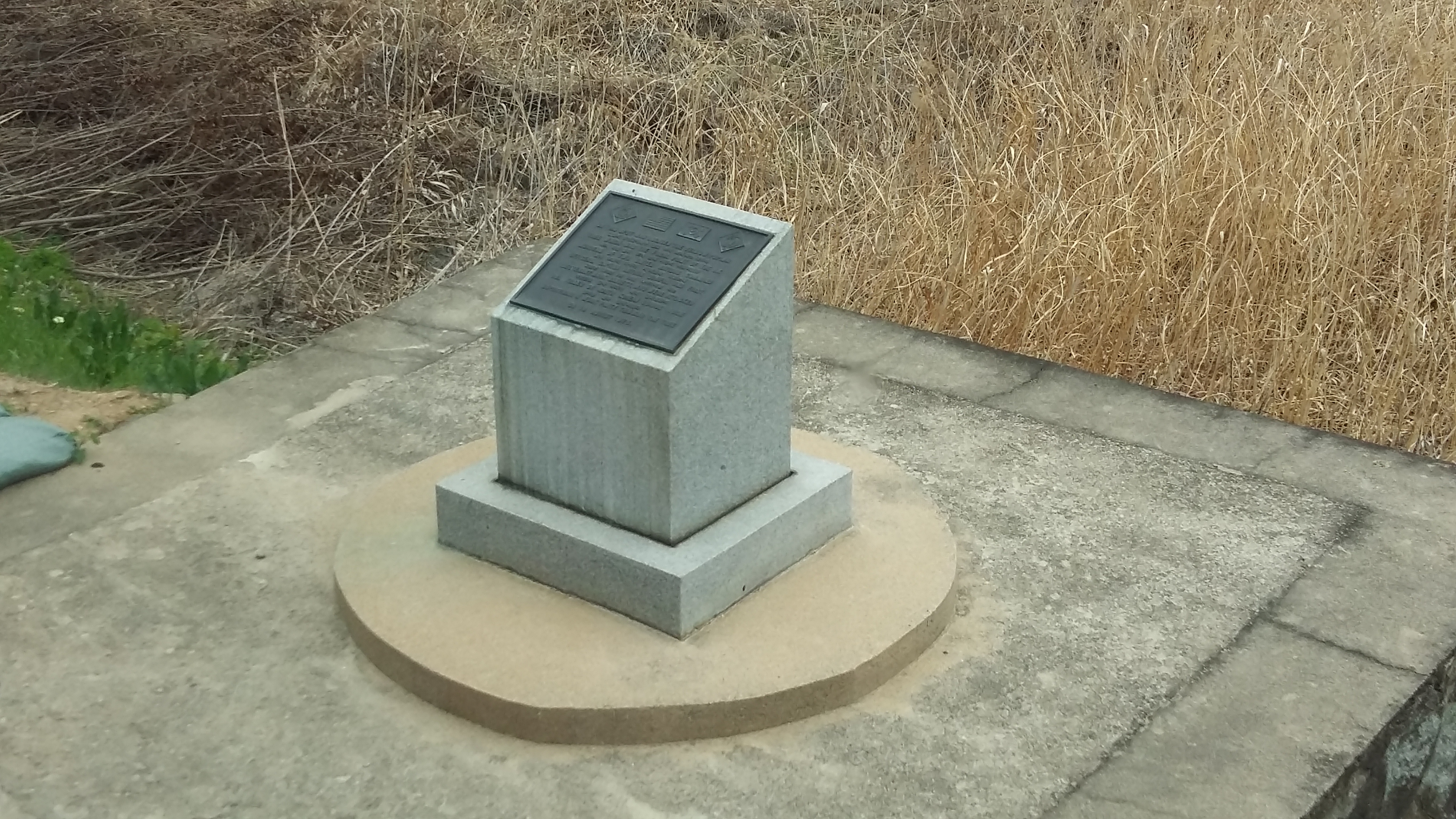
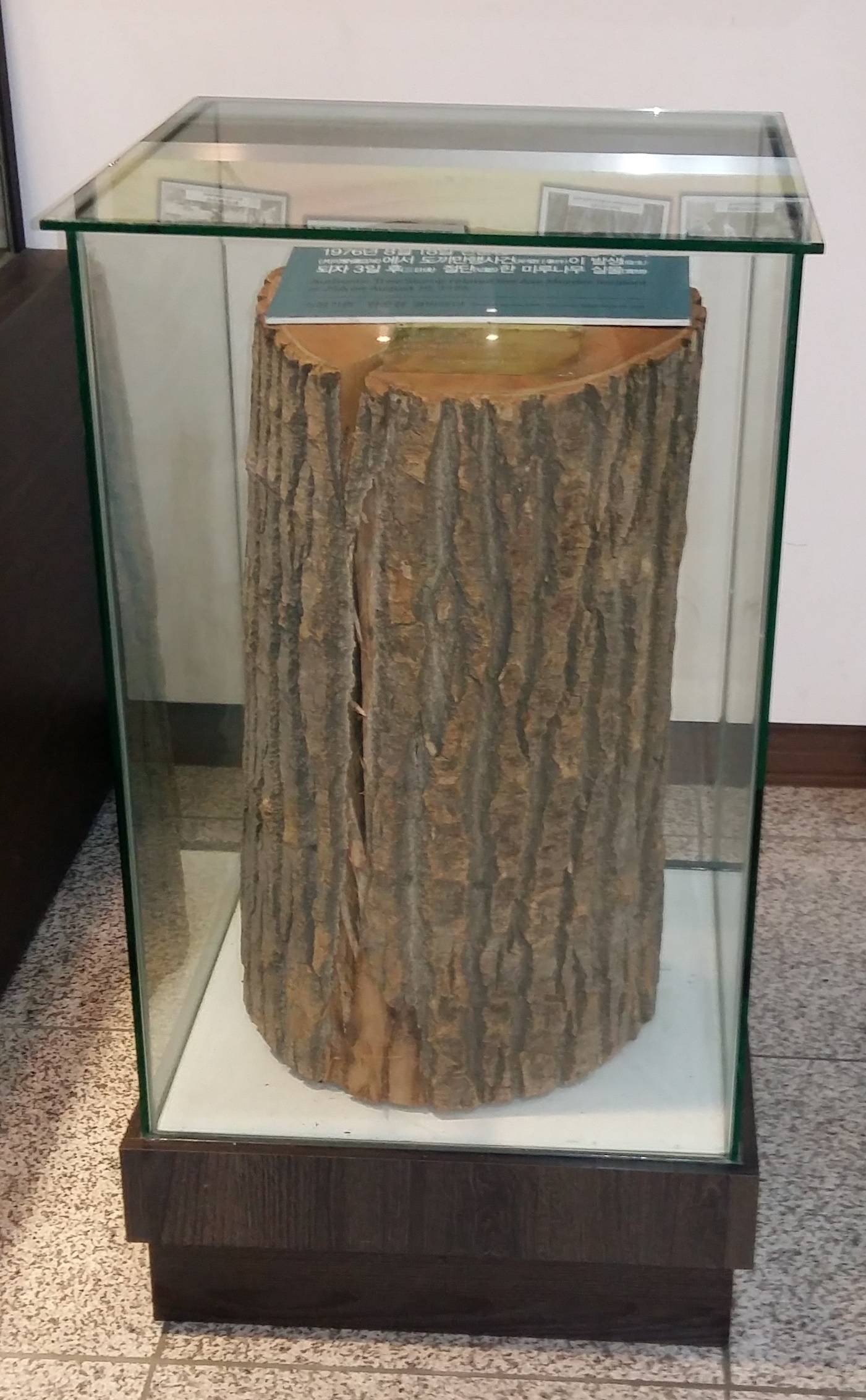
In 1976, a group of United Nations Soldiers were trimming limbs from a large tree in the DMZ which was blocking the line of site between two guard posts when they were attacked by a group of North Korean soldiers. 2 U.S. officers and 4 South Korean Soldiers were killed. Today, there is a monument near where the attack took place which was near the Bridge of No Return.
The monument honoring the deaths of U.N. Soldiers killed with their axes by North Korean soldiers. The round base of the monument is the size of the tree the U.N. Soldiers were trimming.The stump of the tree involved in the 1976 ax murders located in the museum at the JSA Visitor’s Center
.
A view of North Korea from an observation post near Panmunjeom. In the center of the picture is Gijeong-dong Village, built by the North for propaganda, but there are many things that indicated it is not lived in but rather a “fake” city housing only some soldiers. The tower holding the North Korean flag is said to be the world’s tallest flag tower.
.
For several miles along Highway 77, between Seoul and Peju, there are double fences with barbed wire and guard towers every few hundred feet. A vivid reminder how close the people of Korea are to war.
On a recent visit to Camp Humphreys in Pyeongtaek, I went with one of my battalion chaplains and a visiting chaplain into “The Ville” to eat lunch at a restaurant called Braai Republic (down the main road of “The Ville” a couple of blocks, on the left then go to the 2nd floor). The battalion chaplain who was our guide said that it appeals to Americans because it’s a “meat and potatoes” restaurant (which appeals to me!) though the entrees are prepared a special way.
The Braai Republic in Pyeongtaek is on the 2nd floor of a building a couple of blocks from Camp Humphreys (“Visions” is another establishment on the 1st floor).
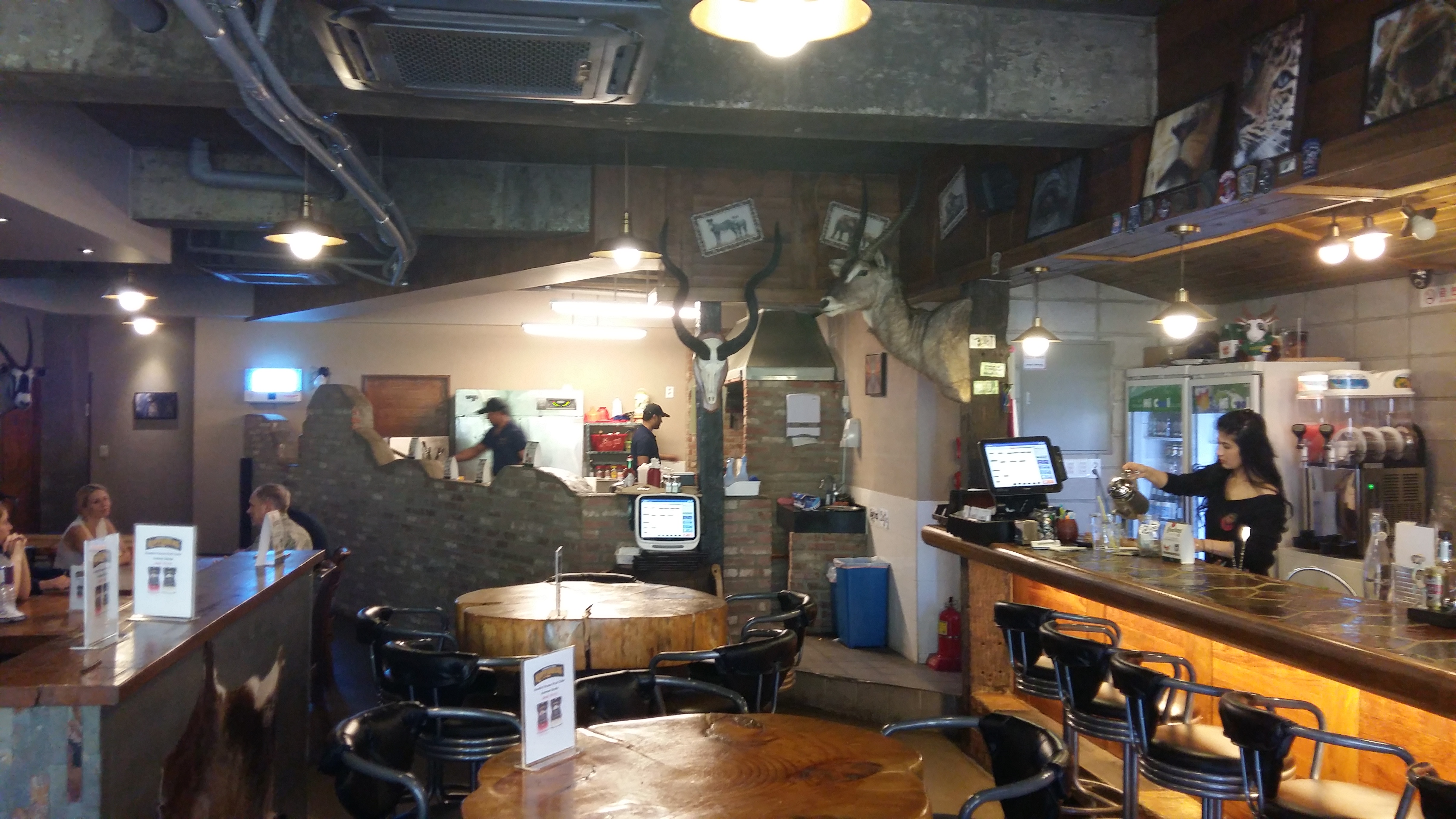
Braai Republic advertises itself as “A Taste of Africa,” serving “Traditional South African Food.” I’ve never been to any country in Africa or eaten at a fully African-themed restaurant, so I don’t have those comparisons to draw from, but can evaluate the food on its own merits. Walking into the restaurant, it looks very African in color and decor. There are a variety of stuffed animal heads lending to the African feel.
The menu has a good variety of meats: beef, lamb, chicken and pork. Many of the names are European in origin as well as uniquely South African and Zimbabwean. There are Lamb & Pork Chops, Pork Ribs, Bangers, Boerewors, Pap and Wors, Oxtail Stew and Potjie, Prawns, Biltong, Droewors and a variety of pies: Lamb, Chicken, Pork, Mixed Meat and Spinich & Potato. Also on the menu is Peri-Peri chicken, wholly roasted, in a sandwich and livers.
The sides are mainly common ones, though some with an ethnic twist: Potato Fries, Green Salad, Slaw, Creamy Spinach, Curried Green Beans, Garlic Potatoes, and carrots.
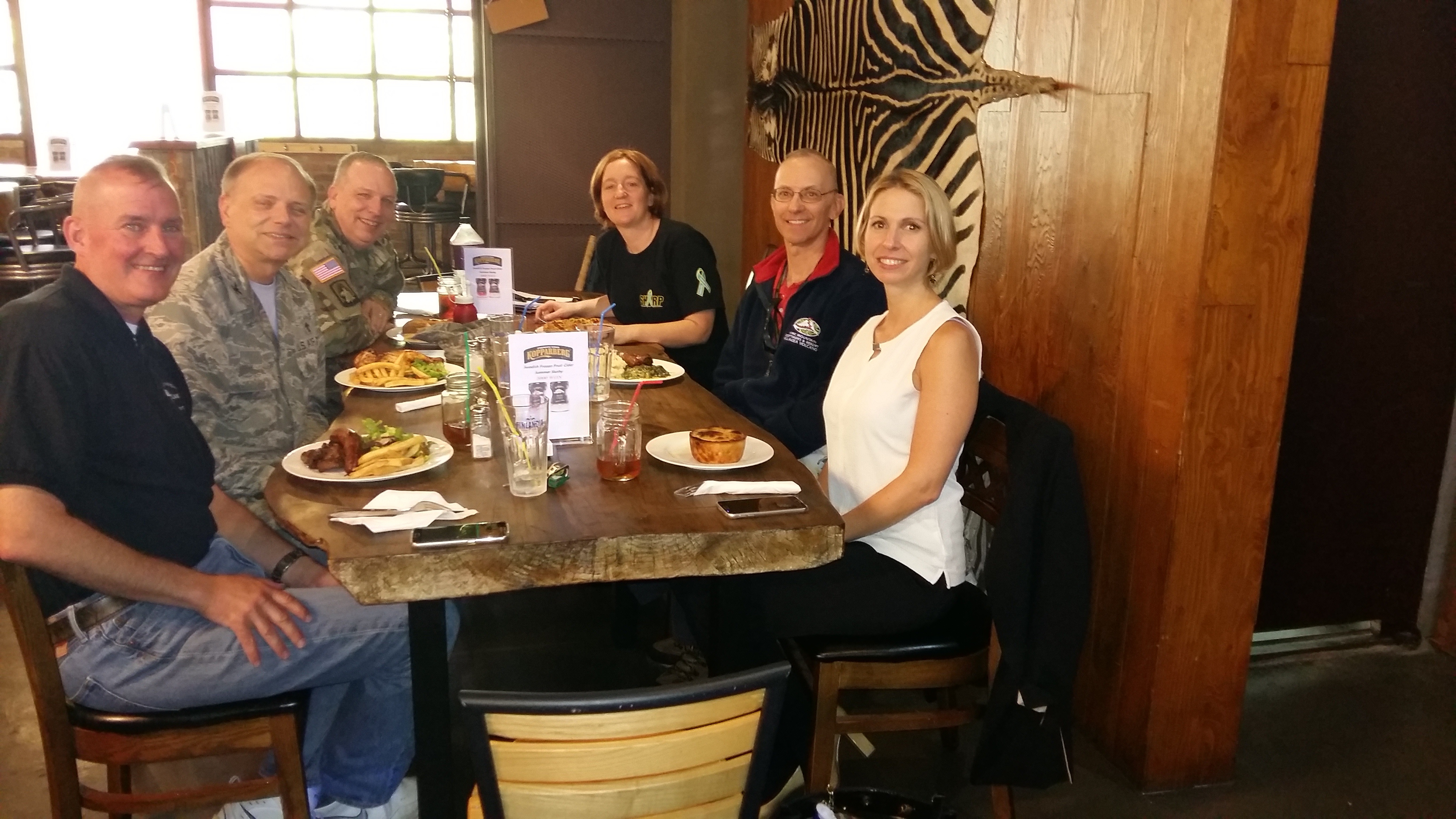
Our group ordered a variety of entrees from the menu, realizing that each meat dish is prepared and cooked when it’s ordered. The first to order asked for the Chicken Pie, which was the last they had. Another ordered Lamb Chops which looked very good. Someone else ordered Peri-Peri Chicken (a marinated half-chicken). I ordered the Peri-Peri Chicken Sandwich with Potato Fries and the battalion chaplain, not having much time because of an appointment, just ordered Garlic Bread, which came with a number of toppings making it almost a meal on its own.
Everyone spoke of their meals being good, but I can only speak to mine. First, the iced sweet tea came in a handled mason jar. It’s brewed fresh (with the tea bag still in the glass when it arrived). The taste was a bit different from “American” sweet tea, apparently being sweetened with honey.
I ordered my Peri-Peri Chicken Sandwich with Potato Fries instead of the Green Salad, not knowing what may be in the salad or what the dressings may be like. I wondered, with a name like “Potato Fries,” if they would be any different than American “French Fries” and discovered they weren’t, but they were very good, certainly better that fast-food French Fries.
I’ve had Peri-Peri Chicken before, but at an Afro-Portuguese restaurant in Qatar, called Nando’s Peri-Peri. I assumed it would be similar, which it was. The sandwich came on a hoagie-type bun with shredded chicken marinated in the Peri-Peri spice. It had a thin white sauce along the top, though I’m not certain what that sauce was. While the type of bun was more bread than I would prefer, the taste of the sandwich -with the seasoning and sauces- was very, very good. It did remind me of the Peri-Peri chicken that I ate at Nando’s, which is a pleasant memory. There wasn’t a choice of levels of spicy (at Nando’s, I’d get “mild”) so had to take what I received. It was what I would label as medium-spicy. Spicy enough that I needed to get an additional glass of water but not so spicy that I couldn’t enjoy the flavor. The Peri-Peri Chicken Sandwich was a great choice, and one that I will make again…after I sample the other items on the menu which all also look great.
I would highly recommend Braai Republic if you’re looking for “meat and potatoes” with a bit of spice and good side dishes. And, I found out while writing this review that not only is there a Braai Republic near Camp Humphreys (where I ate), there is also one in Itaewon near USAG Yongsan (their website is here), so I’m looking forward to eating at Braai Republic again soon!
Additionally, I discovered that the same owners of the restaurant have a shop where a variety of sausages and cured and dried meats can be purchased. Here is a link to the store’s website, which also has good descriptions of the types of meat they sell at the store as well as serve in the restaurants: The Biltong Guy Shop.






















































 Chaplain News from the Front
